Finding the right retail space for rent in the 16th arrondissement Paris requires a clear understanding of the neighbourhood's commercial landscape, legal framework, pricing dynamics, and activation calendar. The 16ème arrondissement is one of the most prestigious districts in France, home to Trocadéro, rue de Passy, Avenue Victor Hugo, and the Fondation Louis Vuitton, attracting international brands, luxury boutiques, and high-footfall fashion showrooms. Whether you are planning a pop-up store, a temporary fashion showroom, or a short-term point de vente, the 75016 postcode offers a range of commercial premises that few other arrondissements can match for brand cachet. Fashion Week Venues supports brands navigating Paris retail activations from space discovery through to full activation management.
Why the 16th Arrondissement Is a Strategic Retail Location in Paris
Quick answer: The 16ème arrondissement offers unparalleled brand prestige, proximity to major cultural landmarks including the Tour Eiffel, Palais de Tokyo, and Arc de Triomphe, a high-net-worth residential base, and strong foot traffic along routes such as rue de Passy and Avenue Victor Hugo, making it one of the most effective locations in Paris for luxury retail and temporary brand activations.
The 16th arrondissement sits in the western edge of Paris, bordered by the Bois de Boulogne, the Champs de Mars, and the Seine. It encompasses several distinct retail and commercial sub-zones that each carry their own character and commercial logic. The rue de Passy corridor functions as an established high street with boutiques, galeries, and local commercial units ranging from compact storefronts to larger surface totale properties. Trocadéro commands some of the most photographed views in France with direct lines of sight to the Tour Eiffel, creating natural footfall and media value for brands that activate here. Avenue Mozart and Avenue Paul Doumer anchor quieter but highly affluent residential retail strips, while Avenue Victor Hugo and Porte Dauphine connect the arrondissement to the Golden Triangle and the broader luxury axis running toward the Champs-Élysées and George V.
The commercial demographic of Paris 16 is shaped by its residents. This arrondissement consistently ranks among the highest in Paris for household income, with a concentration of finance professionals, diplomatic households, and established family wealth. The proximity to major corporate headquarters, including those of L'Oréal and Lagardère, means that the daytime commercial population includes professional decision-makers who are also active luxury consumers. For brands targeting high-net-worth individuals, this convergence of residential affluence and corporate presence is a significant strategic asset.
Transport connectivity supports this consumer profile. The arrondissement is served by multiple Metro lines, RER C which connects to central Paris and beyond, Transilien L reaching the western suburbs, and an extensive Vélib cycling network. This accessibility means that a retail space or showroom in 75016 draws visitors not just from within the arrondissement but from across the western half of Paris and international visitors navigating between major monuments.
The cultural infrastructure of the area amplifies brand visibility. The Palais de Tokyo is one of Europe's leading contemporary art institutions and regularly hosts brand events and private activations. The Fondation Louis Vuitton, designed by Frank Gehry and located at the edge of the Bois de Boulogne, has become one of Paris's most visited destinations and a natural reference point for luxury brand activations. The Hôtel Mona Bismarck and the Acacias Art Center provide event infrastructure used by international fashion and luxury brands during Paris Fashion Week and beyond. The Grand Palais, while technically in the 8th, draws enormous traffic that spills across into the 16th corridor.
For fashion brands specifically, the 16ème arrondissement sits comfortably within the fashion geography of Paris. During Fashion Week, the district hosts showrooms, press presentations, and private sales events. The proximity to the triangle d'or and the Golden Triangle means that international buyers, press, and stylists moving between appointments will pass through or deliberately visit the 16th as part of their Paris itinerary.
DID YOU KNOW: The 16ème arrondissement has the highest concentration of Haussmannian architecture of any arrondissement in western Paris, giving commercial spaces in this district a distinctive aesthetic that many luxury brands actively seek for editorial and activation purposes.
KEY TAKEAWAY: The 16th arrondissement is not simply an expensive postcode. It is a strategically coherent retail environment combining high-net-worth consumers, cultural landmarks, international visitor footfall, and strong transport links, all of which contribute directly to the commercial performance of retail spaces and pop-up activations in 75016.
Understanding why brands target this arrondissement is only the starting point. The next step is understanding the types of spaces actually available here and how they match different activation formats.
Types of Retail and Commercial Spaces Available in Paris 16
Quick answer: The 16th arrondissement offers a broad spectrum of commercial premises, from traditional local commercial units and boutique storefronts on rue de Passy to Haussmannian apartments used as fashion showrooms, art galleries converted for temporary retail, and architectural spaces near Trocadéro suitable for brand events and pop-up stores.
Commercial real estate in the 16ème arrondissement covers a wide range of typologies. Understanding the distinctions between these space types is essential for matching your activation format to the right property category.
Traditional Storefronts and Local Commercial Units
The most common commercial premise type along rue de Passy, Place de Passy, and Avenue Victor Hugo is the traditional storefront or local commercial. These units typically occupy ground-floor retail positions in Haussmannian or early 20th century buildings, with street-level glazing, direct pedestrian access, and surface totale ranging from small boutique formats of around 30 to 60 square meters up to larger multi-room configurations exceeding 200 square meters. Many include a Terrasse space or external footprint that can be used for brand display or seasonal activations. These are the spaces most commonly associated with POINT DE VENTE operations, whether permanent boutiques or temporary pop-up stores.
Fashion Showrooms and Private Presentation Spaces
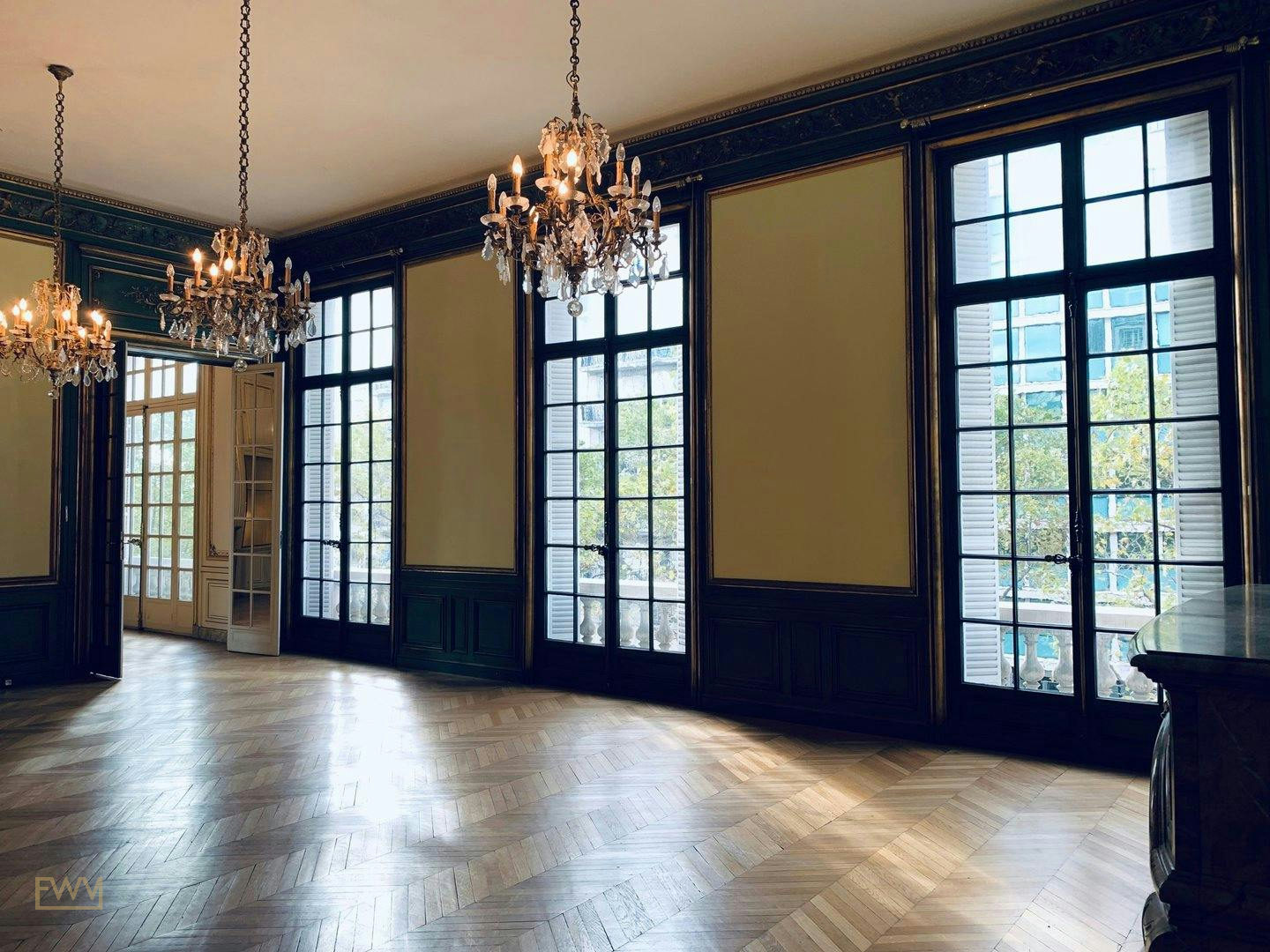
The 16th is particularly well suited to fashion showroom formats. Many spaces in immeuble haussmannien buildings on streets such as rue Nicolo, Avenue Paul Doumer, and rue d'Auteuil have been configured or adapted for seasonal showroom use. These spaces typically feature architecture prestigieuse, high ceilings, parquet flooring, ornate moulures, and generous natural light through tall windows. Brands use these spaces for trade appointments during Fashion Week, press presentations, wholesale buying events, and private client sales. The residential character of these streets means that a Fashion Showroom in this part of Paris carries a sense of exclusivity and discovery that a more commercial location cannot replicate.
Luxury Haussmannian Apartments Used for Commercial Purposes
A distinctive feature of the Paris 16 rental market is the availability of Appartement Haussmannien configurations for temporary commercial use. These are residential or mixed-use spaces that have been adapted to accommodate activations such as product launches, brand presentations, editorial shoots, and private sales. A Luxury architecturally-designed Haussmannian apartment with kitchen, bathroom, and loft-type living area can function as an immersive brand environment that feels entirely unlike a standard retail or event venue. This format is especially popular during Fashion Week for brands seeking intimate, appointment-driven experiences.
Gallery and Art Spaces
The 16th arrondissement has a significant concentration of art galleries and Galerie d'art spaces, particularly around Trocadéro, rue de Passy, and the Village d'Auteuil. These white-wall environments with rail lighting, carrelage or parquet flooring, and flexible interior configurations make them ideal for fashion presentations, product launches, and Boutique galerie hybrid activations. Brands activating in gallery spaces benefit from the cultural credibility of the location and an environment that supports high-quality visual merchandising.
Studio, Photo, and Event Spaces
A growing category in Paris 16 is the Studio Photo et Tournage or Salle de Conférence format. These spaces are specifically configured for content creation, media production, and corporate events. They typically feature controlled lighting, modular layouts, and technical infrastructure. Brands use them for product photography, interview content, launch events, and brand workshops. The availability of this space type within the 16th reflects the concentration of media and communications businesses operating in the arrondissement, including those connected to major corporate tenants in adjacent zones.
Specialist Formats Including Péniche and Outdoor Terraces
Along the Seine, the arrondissement also offers Péniche spaces and riverside terraces that carry a strong visual identity and media appeal. These are less common as traditional retail spaces but are used effectively for brand events, press activations, and seasonal pop-up formats, particularly during warmer months when the outdoor component significantly enhances the brand experience.
| Space Type | Primary Use | Typical Surface | Best For |
|---|---|---|---|
| Local Commercial Storefront | POINT DE VENTE, pop-up store | 30 to 250 sq m | Direct retail, temporary boutique |
| Haussmannian Apartment | Showroom, private sales, presentations | 80 to 300 sq m | Fashion Week showroom, brand immersion |
| Galerie d'Art | Brand presentation, pop-up boutique | 50 to 200 sq m | Luxury launches, editorial activations |
| Studio Photo and Tournage | Content creation, media events | 100 to 400 sq m | Brand campaigns, influencer content |
| Salle de Conférence | Press events, trade meetings | 50 to 150 sq m | Buyer appointments, brand briefings |
| Péniche and Riverside | Brand events, seasonal activations | Varies | Experiential launches, press dinners |
KEY TAKEAWAY: The 16th arrondissement offers far more than standard storefront retail. Brands should assess their activation format carefully before searching, as the right space type, whether a showroom apartment, a galerie, or a traditional storefront, will determine both the brand experience and the applicable legal and regulatory framework.
Selecting the right space type is inseparable from understanding the neighbourhood sub-zones within Paris 16, each of which has its own commercial logic and visitor profile.
Key Neighbourhoods and Streets Within the 16th Arrondissement for Retail
Quick answer: The 16ème arrondissement divides into several distinct commercial zones, including the Trocadéro and rue de Passy high street, the Avenue Victor Hugo luxury corridor, the Auteuil residential village around rue d'Auteuil and Village d'Auteuil, and the Porte Dauphine and Jasmin metro station zones, each offering different space types, price points, and brand audiences.
Brands entering the Paris 16 retail market often treat the arrondissement as a single entity, but in practice it functions as several overlapping commercial micro-markets. Understanding these distinctions allows brand teams to match their target consumer, activation format, and budget to the most appropriate sub-zone.
Trocadéro and Place de Passy
The area immediately surrounding Trocadéro and extending along rue de Passy toward Place de Passy represents the highest-footfall commercial corridor in the arrondissement. The iconic view of the Tour Eiffel from the Trocadéro esplanade attracts millions of visitors annually, and the retail streets adjacent to this axis benefit from a combination of tourist footfall, residential shopping traffic, and fashion-adjacent visitors attending events at the Palais de Tokyo and Fondation Louis Vuitton. Retail spaces here tend to command premium rents, reflect the highest surface totale availability, and attract international brands seeking both visibility and prestige.
Avenue Victor Hugo and the Golden Triangle Axis
Avenue Victor Hugo is one of the most commercially active streets in Paris 16, running from Place Victor Hugo toward the Arc de Triomphe and the Golden Triangle. This corridor connects the 16th to the luxury axis of the 8th arrondissement, which includes George V, the Champs-Élysées, and the triangle d'or. Brands occupying retail space along Avenue Victor Hugo benefit from the walk-through traffic of high-net-worth consumers moving between these zones. Spaces here range from boutique storefronts to larger commercial premises suitable for showrooms and multi-brand pop-up formats.
Auteuil Village and rue d'Auteuil
The Village d'Auteuil in the southern part of the 16th offers a quieter, more residential retail environment. Rue d'Auteuil, rue Nicolo, and surrounding streets host a mix of independent boutiques, design studios, art galleries, and specialist retail formats. This sub-zone is particularly attractive for brands seeking a curated, appointment-driven experience rather than mass footfall. Fashion showrooms, emerging designer presentations, and lifestyle brand activations perform well here because the environment supports discernment and discovery rather than volume.
Avenue Paul Doumer and Avenue Mozart
These two axes represent the residential retail heart of Paris 16, serving an affluent local population with a preference for quality over novelty. Commercial spaces along Avenue Paul Doumer and Avenue Mozart tend to be Haussmannian storefronts with strong visual identity, suitable for boutique fashion retail, home and lifestyle brands, and neighbourhood-scale pop-up activations. The loyer levels here are generally lower than on rue de Passy or Avenue Victor Hugo, making these streets viable options for brands with more constrained budgets who still want the credibility of a 75016 address.
Porte Dauphine and Jasmin Metro Station Zone
The northern edge of the arrondissement near Porte Dauphine connects to the Bois de Boulogne and offers a small cluster of commercial spaces and event venues that are well positioned for corporate events, private client activations, and brand experiences requiring a quieter setting with excellent transport access. The Jasmin metro station area serves as a local commercial node with spaces suited to neighbourhood retail and small-format showrooms.
To compare locations and understand which sub-zones best match your activation brief, use the space locator tool on Fashion Week Venues to filter by neighbourhood, space type, and availability.
| Sub-Zone | Key Streets and Landmarks | Best Space Types | Visitor Profile |
|---|---|---|---|
| Trocadéro and Passy | rue de Passy, Place de Passy, Palais de Tokyo | Storefront, galerie, showroom | Tourist, luxury consumer, fashion professional |
| Victor Hugo Corridor | Avenue Victor Hugo, Arc de Triomphe | Boutique, showroom, pop-up | High-net-worth residential, Golden Triangle visitor |
| Auteuil Village | rue d'Auteuil, rue Nicolo, Village d'Auteuil | Apartment showroom, galerie | Curated, appointment-driven, affluent local |
| Mozart and Doumer | Avenue Mozart, Avenue Paul Doumer | Haussmannian storefront, boutique | Affluent residential, local shopping |
| Porte Dauphine and Jasmin | Porte Dauphine, Jasmin metro | Event space, corporate venue | Corporate, private client, local residential |
KEY TAKEAWAY: Choosing the right sub-zone within the 16th arrondissement is as important as choosing the right space type. Each corridor serves a different visitor profile and activation format, and brands should map their target consumer journey against these micro-markets before committing to a location.
Once the location strategy is clear, brands need to understand the legal and financial framework that governs retail space rental in Paris 16, which is meaningfully different from standard short-term commercial leasing in other markets.
Legal Framework for Renting Commercial Space in Paris: Bail Commercial, Bail Précaire, and AOT
Quick answer: Renting retail or commercial space in Paris involves three main legal frameworks: the standard bail commercial for long-term leases of three years or more, the bail précaire or bail dérogatoire for short-term agreements of up to three years, and the autorisation d'occupation temporaire for temporary use of public or private spaces. Each has different obligations, protections, and compliance requirements that brand teams must understand before signing.
Commercial real estate in France is governed by a specific legal framework under the Code de commerce. Unlike many other markets where short-term rental agreements are relatively straightforward, the French system creates distinct categories of tenancy with different rights, obligations, and legal consequences. Brands planning a pop-up store, temporary boutique, or short-term fashion showroom in the 16th arrondissement need to understand which legal framework applies to their specific activation before committing to a space.
Bail Commercial: The Standard Long-Term Commercial Lease
The bail commercial is the standard form of commercial lease in France, typically structured on a 3-6-9 year basis, meaning the tenant commits to a minimum of three years with renewal rights at six and nine year intervals. A bail commercial grants the tenant significant legal protections including the right to renewal and compensation if the landlord refuses to renew. For brands seeking a temporary activation of weeks or months rather than years, the bail commercial is generally not the appropriate structure. However, some landlords of vacant premises in the 16th may attempt to apply bail commercial terms to short-term arrangements, which brands should avoid without specialist legal advice.
Bail Précaire and Bail Dérogatoire: Short-Term Commercial Rental
The bail dérogatoire, also known as the bail précaire or convention d'occupation précaire, allows commercial parties to agree a short-term rental of up to three years without the full protections and obligations of a bail commercial. This is the legal structure most commonly used for pop-up stores, temporary boutiques, seasonal showrooms, and short-term fashion activations in Paris. Under a bail dérogatoire, the tenant does not acquire the right to renewal or commercial compensation, and the agreement can be structured for periods ranging from a few days to several months. It is essential that both parties clearly document the temporary nature of the occupation and that the agreement does not inadvertently create bail commercial rights through behaviour or duration that exceeds the permitted threshold.
IMPORTANT: If a bail dérogatoire is allowed to continue beyond the statutory maximum duration without being converted to a formal bail commercial, French law may automatically reclassify the tenancy as a bail commercial, triggering the full statutory protections and obligations. Brand teams must track duration carefully and take legal advice on any extension.
Autorisation d'Occupation Temporaire (AOT)
For brands activating in public spaces, on public property, or in spaces governed by specific co-ownership or institutional arrangements, the Autorisation d'Occupation Temporaire provides a framework for temporary use without establishing a conventional tenancy. AOTs are commonly used for activations on public squares, pedestrian zones, and in institutional venues such as museums or cultural foundations. The terms, duration, permitted uses, and compliance requirements of an AOT vary significantly depending on the property type, the arrondissement, and the authorising body. Brands planning activations in or adjacent to landmarks in the 16th such as the Palais de Tokyo or spaces near the Champs de Mars should verify which framework applies to their specific location.
Co-Ownership Regime and Carrez Law
Many commercial spaces in Haussmannian buildings in Paris 16 sit within a co-ownership regime, meaning the building is managed by a syndicat de copropriété. This can impose restrictions on commercial use, opening hours, signage, structural modifications, and even the type of business that can operate from the premises. The Carrez law governs the measurement and declaration of surface area in co-ownership properties, meaning the declared surface totale of a space must be verified against the Carrez measurement before any rental agreement is signed. Discrepancies between advertised and measured surface area are not uncommon and can affect both the legal validity of the agreement and the applicable loyer calculation.
Practical Compliance Considerations
Beyond the lease structure, brands renting commercial space in Paris 16 must consider a range of compliance matters including business registration or the use of an entity with the right to operate commercially in France, insurance obligations specific to the space and activation type, compliance with local planning and commercial use permissions, and any specific requirements related to conduits, Conduit de cheminée, Restauration sans conduit, or food and beverage service if the activation includes hospitality elements. Requirements vary by space type, duration, intended use, and the specific arrondissement. Brands should always verify their compliance position with a qualified French legal advisor before entering into any commercial space agreement in Paris.
For practical guidance on permit requirements relevant to your activation, use the permit guidance tool on Fashion Week Venues to understand which frameworks apply to your space type and activation format.
KEY TAKEAWAY: The French commercial property framework is more complex than short-term retail markets in many other countries. Understanding the distinction between bail commercial, bail dérogatoire, and AOT, and verifying co-ownership restrictions and Carrez measurements before signing, is essential to avoiding costly legal complications during or after your Paris activation.
The legal framework directly affects budget planning, because the structure of your agreement determines which costs fall to the tenant and how charges, taxes, and loyer are calculated.
Understanding Costs: Loyer, Charges, Taxes, and Budget Planning for Paris 16 Retail Space
Quick answer: Renting retail space in the 16th arrondissement involves the base rent expressed as loyer Hc/ht/mois or Hc/mois, service charges, local commercial taxes including the taxe foncière and cotisation foncière des entreprises where applicable, fit-out and production costs, and any agency fees. Total activation cost depends heavily on space type, surface totale, duration, and the scope of works required.
Budget planning for a retail space activation in Paris 16 involves multiple cost layers that brands frequently underestimate when focused solely on the headline loyer figure. A complete budget picture must account for each of the following categories.
Base Rent: Hc/ht/mois and Hc/mois
Commercial rents in Paris are typically quoted as hors charges hors taxes par mois (Hc/ht/mois), meaning the rent figure excludes service charges and taxes, or as hors charges par mois (Hc/mois), meaning it excludes only charges. The distinction matters because the charges and taxes applicable to a commercial space in 75016 can represent a meaningful addition to the headline rent figure. Brands comparing spaces across listings should always request the full cost of occupation, not just the loyer, to ensure accurate budget planning. The 16th arrondissement consistently commands premium rent levels relative to many other Paris arrondissements, reflecting the address prestige and consumer profile of the area. Exact current market rates vary significantly by street, space type, surface, and availability, and should be verified directly with space owners or through a qualified agent or marketplace. Use the budget estimation tool on Fashion Week Venues for directional cost planning specific to your space type and activation format.
Service Charges and Operating Costs
Charges in a commercial rental context cover building maintenance, common area costs, concierge or security services, utilities where not separately metered, and in co-ownership buildings, contributions to the syndicat de copropriété budget. For short-term activations under a bail dérogatoire, the allocation of charges between landlord and tenant should be explicitly agreed and documented in the rental agreement. Brands should not assume that charges are included in the quoted loyer without verification.
Taxes Applicable to Commercial Space
Depending on the legal structure of the rental, the space type, and the duration, commercial tenants in France may be subject to the taxe foncière contribution (sometimes passed through by landlords), the cotisation foncière des entreprises for businesses established in France, and TVA on the rent if the landlord has opted into the TVA regime for commercial rentals. Short-term activations using a bail dérogatoire may have different tax treatment from standard bail commercial arrangements, and international brands operating through a temporary commercial arrangement may have specific VAT recovery implications. French tax advice from a qualified professional is essential before finalising the budget for any retail activation in Paris.
Fit-Out, Production, and Activation Costs
Beyond the rental cost, brands must budget for the physical transformation of the space. This includes any structural or decorative modifications, custom fixtures and furniture, branded signage and visual merchandising, POS and payment infrastructure, staffing, and any technical requirements specific to the activation format. For spaces in Haussmannian buildings with co-ownership restrictions, modifications may require approval from the syndicat de copropriété and must be reversed at the end of the tenancy. Fit-out costs for a quality pop-up boutique or fashion showroom in Paris 16 can represent a significant proportion of total activation spend, particularly for brands seeking architecture-level brand environments.
Agency and Professional Fees
If working through a commercial real estate agent, agences partenaires, or a full-service activation agency, professional fees will form part of the total cost. These fees vary by service scope and should be factored into the budget from the outset. Platforms such as BureauxLocaux and Flexas.com aggregate commercial property listings in Paris and may facilitate connections with agences partenaires, but they do not typically provide the activation management, fit-out, or staffing services that a full-service agency offers.
TIP: When comparing spaces across different listings or platforms, always request a full cost breakdown including loyer, charges, taxes, fit-out contribution requirements, and any mandatory deposits or guarantees before making a shortlist decision. A space with a lower loyer that carries high charges and significant fit-out obligations may cost more overall than a higher-loyer space that is activation-ready.
KEY TAKEAWAY: The total cost of a retail space activation in Paris 16 is always higher than the headline loyer figure. Brands must model the complete cost of occupation including charges, taxes, fit-out, staffing, and professional fees to build an accurate budget before committing to a space.
Budget clarity is essential before beginning the space search process, which has its own specific workflow in the Paris commercial real estate context.
How to Find and Secure Retail Space in the 16th Arrondissement Paris
Quick answer: Finding and securing retail space in Paris 16 typically involves a combination of direct outreach to landlords, working with specialist commercial agents or agences partenaires, using digital marketplaces and listing platforms, and engaging a full-service activation agency that can source, negotiate, and manage the entire process on behalf of the brand.
The process of identifying, shortlisting, and securing a commercial space in 75016 is more structured and time-intensive than in many other markets. Paris commercial real estate has its own conventions, gatekeepers, and timelines, and international brands without prior experience in the French market frequently underestimate both the lead time required and the importance of local relationships in securing the best spaces.
Step-by-Step Space Search and Securing Process
| Step | Action | Key Considerations | Typical Timeline |
|---|---|---|---|
| 1 | Define activation brief | Format, surface, duration, budget, calendar window, target neighbourhood | Week 1 |
| 2 | Market search and longlist | Marketplace platforms, agent networks, direct outreach, Fashion Week Venues space catalogue | Weeks 2 to 3 |
| 3 | Space visits and shortlist | Verify Carrez measurements, co-ownership restrictions, technical infrastructure, condition | Weeks 3 to 5 |
| 4 | Commercial negotiation | Loyer, charges, deposit, permitted use, fit-out allowances, reinstatement obligations | Weeks 5 to 7 |
| 5 | Legal review and documentation | Bail dérogatoire or AOT structure, French legal advisor review, co-ownership approvals | Weeks 6 to 8 |
| 6 | Fit-out and production | Design, build, fixtures, POS, staffing, merchandising | Weeks 8 to 12 |
| 7 | Launch and activation management | Opening, events, influencer programme, sales operations | Activation period |
| 8 | Reinstatement and close | Fixtures removal, space restoration, final account settlement | Post-activation |
Using Digital Marketplaces and Listing Platforms
Digital platforms aggregate commercial property listings across Paris and allow brand teams to search by arrondissement, surface, and space type. These platforms can be useful for building a longlist and understanding the range of available properties, but they typically provide limited information on the activation-specific suitability of a space, its technical condition, co-ownership restrictions, or the willingness of the landlord to accommodate a short-term bail dérogatoire arrangement. Brands should treat these platforms as a starting point for research rather than a complete solution for space discovery.
Working With Commercial Agents and Agences Partenaires
Commercial agents operating in the Paris 16 market have established relationships with landlords, building managers, and syndicats de copropriété. A specialist agent focused on the 16th arrondissement can access spaces that are not publicly listed, facilitate introductions to landlords who prefer working with known intermediaries, and advise on the appropriate lease structure for your activation type. The commission model for commercial agents in France is regulated, and brands should clarify the fee structure before engaging an agent.
Engaging a Full-Service Activation Agency
For brands that want a single point of accountability across the entire process from space identification through to activation management, a full-service agency offers the most integrated solution. This approach is particularly valuable for international brands without an existing presence or network in Paris, brands operating to tight timelines during Fashion Week or adjacent seasonal windows, and brands with complex activation requirements spanning multiple service areas such as fit-out, staffing, POS, and influencer programming. Understanding the full scope of agency services available is covered in detail in the section below.
For brands researching the agency selection process, the guide to hiring an activation agency on Fashion Week Venues covers how to assess agency capability, ask the right questions, and structure the engagement.
KEY TAKEAWAY: Securing a quality retail space in Paris 16 requires a structured process that begins well in advance of the intended activation date. Brands that start their search at least 8 to 12 weeks before their target launch date are significantly better positioned to secure the right space at the right terms than those attempting to find and fit out a space within a compressed timeline.
The activation calendar for Paris, and specifically the windows associated with Fashion Week, adds a further layer of timing complexity that brands must factor into their planning.
Paris Fashion Week Calendar and the Optimal Activation Windows for Paris 16
Quick answer: Paris Fashion Week occurs twice annually in February and March for the autumn and winter collections, and in September and October for the spring and summer collections, but the 16th arrondissement is also commercially relevant for pre-season activations, the resort and cruise calendar, trade show adjacents, and year-round luxury retail programmes that are not tied exclusively to the Fashion Week calendar.
The fashion industry calendar in Paris is significantly richer and more complex than the twice-annual runway show weeks that dominate media coverage. Brands planning activations in Paris 16 should understand the full range of commercial windows and how each window affects space availability, rental pricing, footfall, and the composition of the professional and consumer audience in the arrondissement.
During the main Fashion Week periods, the 16th arrondissement becomes a focal point for showroom activities, press presentations, and private sales events. Spaces near Trocadéro, in the Auteuil Village, and along Avenue Victor Hugo command premium pricing during these windows, and availability of quality spaces drops significantly as the calendar approaches. Brands that have not secured their space at least 8 to 10 weeks before Fashion Week opens risk being unable to find a suitable location within 75016 at any price.
However, the calendar windows immediately flanking Fashion Week, typically two to three weeks before and after the main show weeks, offer meaningful activation opportunities at less elevated pricing and with greater space availability. These pre- and post-Fashion Week windows are particularly well suited to wholesale showroom appointments, press preview events, and private client activations that benefit from the Fashion Week atmosphere without competing directly with the concentrated demand of the show period itself.
Beyond Fashion Week, Paris 16 is a viable location for activations tied to the resort and cruise collections presented in June and July, the Paris trade fair calendar which includes major events at adjacent venues, and the summer and winter retail seasons driven by the affluent residential and tourist population of the arrondissement. The proximity to the Fondation Louis Vuitton and Palais de Tokyo means that major cultural programming at these institutions can be leveraged by brands activating nearby, extending the reach of the activation to cultural audiences that may not have been part of the original brand target.
DID YOU KNOW: During Paris Fashion Week, the 16th arrondissement hosts a significant proportion of the private showroom appointments attended by international buyers and press, many of whom specifically seek out the discretion and exclusivity of the arrondissement's residential streets for brand presentations that differ from the more commercially prominent venues in the Marais or Saint-Germain.
To plan your activation timeline against the Fashion Week calendar and understand the lead times required for space search, legal documentation, fit-out, and launch, use the timeline planning tool on Fashion Week Venues.
KEY TAKEAWAY: Paris Fashion Week is the most commercially concentrated window for activations in the 16th arrondissement, but it is not the only viable opportunity. Brands that plan their calendar to include pre-season, resort, or trade-adjacent windows can achieve strong commercial results with less competitive pressure on space availability and pricing.
Planning the calendar and securing the space are necessary but insufficient conditions for a successful activation. Brands also need to consider how the physical environment, visual merchandising, staffing, and operational infrastructure will be managed throughout the activation period.
How Fashion Week Venues Supports Retail Activations in Paris 16
Fashion Week Venues is a full-service pop-up shop agency and space marketplace with Paris as its primary market. The agency supports brands across every stage of the activation process, from initial space discovery through to post-activation data and analytics. For brands targeting retail space in the 16th arrondissement, Fashion Week Venues offers a combination of curated space access, full-service activation management, and specialist tools that collectively address the most common challenges brands face when activating in Paris.
Space Discovery and Venue Sourcing
The Fashion Week Venues venue sourcing service gives brand teams access to a curated catalogue of spaces in Paris 16 and across other major fashion capitals. Rather than relying on generic commercial property platforms, brands working with Fashion Week Venues benefit from pre-vetted spaces, established landlord relationships, and specialist knowledge of which spaces are genuinely suitable for fashion showrooms, pop-up stores, brand events, and temporary retail activations. The marketplace also enables direct browsing by city, neighbourhood, space type, and surface area.
Concept Direction and Branded Store Design
Once a space is identified, the concept direction service helps brands translate their creative brief into a spatially coherent activation concept. Working within the specific architectural language of Paris 16, whether a Haussmannian apartment, a gallery space, or a traditional storefront, the concept direction team develops proposals that respect the existing environment while delivering a distinctive brand statement. This is complemented by the branded store design service which handles the visual identity of the space, including fixtures, finishes, lighting, and spatial flow.
Production, Build, and Fit-Out
The physical transformation of a commercial space in Paris 16 requires coordination across multiple trades, compliance with co-ownership building rules, and project management against tight activation timelines. The production and build service manages this process end to end, covering structural modifications, custom joinery and fixtures, technology installation, and reinstatement at close of activation. Brands working with Fashion Week Venues on production and build benefit from established relationships with Paris-based contractors who understand both the technical and regulatory requirements of working in Haussmannian buildings.
Activation Management, Staffing, and Operations
Running a successful pop-up store or fashion showroom in Paris 16 requires more than a well-designed space. The activation management service covers day-to-day operations including opening logistics, sales and appointment management, event programming, and brand ambassador coordination. The retail staffing service provides bilingual and multilingual staff with experience in luxury retail and fashion activations, ensuring that the consumer and trade experience matches the brand's quality standards throughout the activation period.
Planning and Decision Tools
Fashion Week Venues provides a suite of planning tools that are particularly useful for brand teams in the early stages of scoping a Paris 16 activation. These include tools for budget estimation, ROI calculation, space comparison, timeline planning, permit guidance, and space location. Brand teams working across multiple potential locations can use the compare tool to evaluate spaces against each other on key criteria, and the ROI calculator to model expected return against total activation investment. For brands considering activating in Paris alongside other fashion capitals, the twin co-activation concept available at Fashion Week Venues twin offers a framework for coordinated multi-city activations.
What Fashion Week Venues Does Not Guarantee
Fashion Week Venues does not guarantee the availability of specific spaces, the approval of permits or co-ownership applications, or specific commercial outcomes from any activation. The agency works to maximise the probability of a successful activation through expertise, relationships, and process, but brand teams should understand that the Paris commercial real estate market involves independent third-party landlords, regulatory bodies, and market conditions that are outside any agency's direct control. Brands should review the agency process page to understand how Fashion Week Venues structures its work and what each stage of engagement involves.
KEY TAKEAWAY: Fashion Week Venues offers brand teams a single point of accountability for the full activation journey in Paris 16, from space discovery and legal framework navigation through to fit-out, staffing, and post-activation analytics. This integrated approach is particularly valuable for international brands activating in Paris for the first time or operating under tight Fashion Week timelines.
Common Myths About Renting Retail Space in the 16th Arrondissement Paris
MYTH: You need a French legal entity to rent commercial space in Paris 16.
FACT: International brands can rent commercial space in Paris under certain temporary use structures without establishing a full French legal entity, though the specific arrangements depend on the type of rental agreement, the landlord's requirements, and the nature of the commercial activity. Many short-term pop-up and showroom activations in Paris are facilitated through specific contractual structures that allow international entities to operate. This does not eliminate the need for legal advice, and brands should always verify their specific situation with a qualified French lawyer before committing to any commercial space agreement.
MYTH: Paris Fashion Week is the only viable commercial window for activating in the 16th arrondissement.
FACT: Paris Fashion Week is the highest-density commercial window for fashion brands, but the 16ème arrondissement supports a year-round retail ecosystem driven by its affluent residential population, international tourist footfall, and proximity to major cultural institutions including the Fondation Louis Vuitton and Palais de Tokyo. Pre-season activations, resort presentations, trade show adjacents, and general luxury retail programmes all perform well in this arrondissement outside the formal Fashion Week calendar. Brands focused exclusively on Fashion Week windows may miss significant commercial opportunities at lower space costs and with less competitive pressure on availability.
MYTH: Commission-based brokers are the only way to access commercial spaces in Paris 16.
FACT: While commercial agents and brokers play an important role in the Paris real estate market and can provide access to unlisted spaces through their networks, they are not the only route to securing a retail space in 75016. Digital marketplaces, direct landlord relationships, specialist pop-up agencies with existing space portfolios, and platforms such as the Fashion Week Venues marketplace all provide alternative routes to space discovery. Brands should evaluate all available channels and consider which combination of approaches best matches their timeline, budget, and activation complexity.
MYTH: Short-term commercial leases in Paris are legally straightforward and can be managed without specialist help.
FACT: The French commercial tenancy framework, including the distinction between bail commercial, bail dérogatoire, and convention d'occupation précaire, involves specific legal requirements, duration thresholds, and documentation standards that are genuinely complex. A short-term arrangement that inadvertently exceeds the permitted duration for a bail dérogatoire can be reclassified by French courts as a bail commercial, triggering significant financial and legal consequences for both parties. International brands in particular should not attempt to navigate these arrangements without qualified French legal advice, regardless of how straightforward a landlord or agent may present the agreement as being.
MYTH: The 16th arrondissement is only suitable for luxury brands with very large budgets.
FACT: While the 16ème arrondissement does include premium commercial locations that command top-tier rents, the arrondissement also contains a range of space types and sub-zones at varying price points. Smaller format spaces in the Auteuil Village, along Avenue Paul Doumer, or in the Jasmin metro station zone offer access to the 75016 address and its associated consumer credibility at costs more accessible than the flagship rue de Passy or Trocadéro locations. Brands with emerging positions can use these sub-zones strategically to build presence in the 16th without requiring the budgets associated with major flagship activations.
Frequently Asked Questions About Retail Space for Rent in the 16th Arrondissement Paris
What types of retail space are available for rent in the 16th arrondissement of Paris?
The 16ème arrondissement offers a wide range of commercial space types including traditional storefronts and local commercial units along rue de Passy and Avenue Victor Hugo, Haussmannian apartments adapted for showroom and boutique use, art galleries and galerie d'art spaces suitable for brand presentations, studio and photography spaces, conference and event rooms, and riverside or terrace venues. Each space type is suited to different activation formats, and the right choice depends on your brand positioning, target visitor profile, surface requirements, and activation duration. Brands should define their format clearly before beginning the search process to avoid evaluating unsuitable spaces.
Do I need to establish a French company to rent commercial space in Paris 16?
Not necessarily. Short-term commercial activations in Paris can sometimes be structured under bail dérogatoire or convention d'occupation précaire arrangements that accommodate international entities without a French company structure, depending on the landlord's requirements and the specific space type. However, the position varies case by case, and the nature of the commercial activity, the duration of the activation, and any applicable tax registration requirements may affect what is legally required. Brands should always obtain qualified French legal and tax advice before finalising any commercial space agreement in Paris to confirm what entity structure is required for their specific situation.
How far in advance should I book a retail space in Paris 16 for Fashion Week?
For Fashion Week activations, the recommended lead time for beginning the space search is at least 8 to 12 weeks before your intended launch date. For the most sought-after spaces in Trocadéro, rue de Passy, or on the Avenue Victor Hugo corridor, competition is intense and the best available spaces are secured significantly earlier. This timeline needs to accommodate not only the space search and legal documentation but also the fit-out, production, staffing, and activation management work that follows agreement. Brands attempting to secure and fit out a quality space in Paris 16 within four weeks of their intended launch are likely to face significant challenges.
What is the difference between a bail dérogatoire and a bail commercial in the context of a Paris pop-up?
A bail commercial is the standard long-term commercial lease in France, typically structured on a 3-6-9 year basis with significant tenant protections including the right to renewal and commercial compensation. A bail dérogatoire, also known as a bail précaire, is a short-term commercial arrangement permitted for up to three years that specifically excludes the statutory protections of the bail commercial. For pop-up stores, temporary boutiques, and short-term showrooms, the bail dérogatoire is generally the appropriate structure. However, it must be properly documented, and the duration must be managed carefully to avoid inadvertent reclassification as a bail commercial under French law. Legal advice is strongly recommended.
What is the Carrez law and why does it matter when renting commercial space in Paris?
The Carrez law establishes the legal methodology for measuring and declaring the habitable or usable surface area of properties within a co-ownership regime in France. For commercial spaces in Haussmannian buildings, which make up a significant proportion of the commercial premises in Paris 16, the Carrez measurement provides the legally authoritative surface totale figure. Discrepancies between the surface advertised by a landlord and the Carrez-certified measurement can affect the validity of the rental agreement and the applicable loyer. Brands should always verify the Carrez measurement of any space they are considering before signing a rental agreement, particularly for spaces quoted by the square meter.
Can I use a Haussmannian apartment in Paris 16 as a fashion showroom or pop-up boutique?
Yes, Haussmannian apartments are widely used as fashion showrooms, private sales spaces, and brand presentation environments in the 16th arrondissement. However, using a residential space for commercial purposes in a co-ownership building requires compliance with the co-ownership regime rules, and the building's règlement de copropriété may impose restrictions on commercial activity, opening hours, visitor numbers, or structural modifications. Brands should verify the permitted use of any apartment space they are considering for commercial activation and ensure that the rental agreement is structured appropriately for the intended use.
What are the main neighbourhoods within Paris 16 for luxury retail and fashion activations?
The primary commercial sub-zones within the 16ème arrondissement for luxury retail and fashion activations are Trocadéro and rue de Passy for high-footfall storefront and gallery activations, Avenue Victor Hugo for the Golden Triangle connection and affluent local consumer traffic, the Village d'Auteuil and rue d'Auteuil for curated showroom and appointment-driven formats, Avenue Paul Doumer and Avenue Mozart for neighbourhood boutique and residential retail, and Porte Dauphine for corporate event and private client formats. Each zone has different pricing, visitor profiles, and space availability characteristics that brands should map against their activation objectives.
What cultural landmarks in the 16th arrondissement can benefit a retail or brand activation nearby?
The 16ème arrondissement has an exceptional concentration of cultural and architectural landmarks that generate significant visitor footfall and brand association value. These include the Trocadéro and its direct view of the Tour Eiffel, the Palais de Tokyo contemporary art museum, the Fondation Louis Vuitton in the Bois de Boulogne, the Arc de Triomphe at the arrondissement's northern edge, the Champs de Mars extending toward the 7th arrondissement, the Hôtel Mona Bismarck, and the Acacias Art Center. Brands activating near these landmarks benefit from both the visitor traffic they generate and the association with the cultural credibility they carry.
How are commercial rents structured in Paris and what additional costs should I budget for?
Commercial rents in Paris are typically quoted as hors charges hors taxes par mois (Hc/ht/mois) or hors charges par mois (Hc/mois). The headline rent figure excludes service charges and, in the case of Hc/ht/mois, excludes applicable taxes. Brands should request a full cost of occupation breakdown from the landlord or agent before making any budget commitment, covering base rent, service charges, tax contributions where applicable, deposit requirements, and any mandatory reinstatement costs. Fit-out, production, staffing, POS infrastructure, and professional fees add significantly to the total activation cost beyond the rental figure alone.
What transport connections serve the 16th arrondissement and how does this affect retail footfall?
The 16ème arrondissement benefits from strong transport connectivity via multiple Metro lines serving stations including Trocadéro, Passy, La Muette, Jasmin, Ranelagh, Porte Dauphine, and Avenue Victor Hugo, as well as RER C serving the arrondissement's southern edge and connecting to major Paris hubs, Transilien L connecting westward, and an extensive Vélib cycling network. This connectivity supports daytime footfall from professional and residential populations across western Paris and facilitates access for the international visitors and fashion professionals who travel through the arrondissement during Fashion Week and major cultural events.
What is the twin co-activation concept and how does it apply to a Paris 16 retail activation?
The twin co-activation concept from Fashion Week Venues enables two compatible but non-competing brands to share a single commercial space in Paris, splitting costs while each delivering their own brand experience. In the context of the 16th arrondissement, where prime space costs can be significant, a twin activation allows brands to access a larger or better-located space than either could justify independently. The arrangement requires careful brand pairing, clear spatial allocation within the shared environment, and shared management of the operational and logistical elements of the activation. The twin concept is particularly well suited to Fashion Week showroom formats where appointment-driven scheduling minimises direct brand overlap.
What services does Fashion Week Venues provide beyond space finding for a Paris 16 activation?
Fashion Week Venues provides a comprehensive range of services covering the full activation lifecycle. These include venue sourcing, concept direction and branded store design, production and fit-out management, activation and operations management, furniture rental, retail staffing with bilingual capacity, POS and payment infrastructure, data and analytics reporting, and influencer marketing programming. The agency also provides planning tools covering budget estimation, ROI modelling, space comparison, timeline planning, and permit guidance. Brands can engage the agency for the full service scope or for specific service areas depending on their internal capability and activation requirements.
Is the 16th arrondissement suitable for pop-up stores targeting a younger or emerging brand audience?
The 16ème arrondissement is primarily associated with established luxury and premium brand positioning, driven by its affluent residential demographic and its concentration of high-end commercial premises. However, the presence of major contemporary cultural institutions including the Palais de Tokyo and the Fondation Louis Vuitton creates a culturally engaged, design-literate audience that extends beyond traditional luxury demographics. Emerging brands with strong design identity and cultural credibility can find relevance in the 16th, particularly in gallery-adjacent or Auteuil Village sub-zones, provided the brand experience and pricing strategy is appropriately calibrated for the audience.
What practical steps should I take if I cannot find a suitable space in Paris 16 through standard listing platforms?
If standard commercial listing platforms do not yield suitable spaces for your activation brief, the next practical steps include engaging a specialist commercial agent with specific focus on the 16th arrondissement, contacting a full-service activation agency with established landlord relationships in Paris 16, using curated marketplace platforms such as Fashion Week Venues that provide pre-vetted activation-ready spaces, exploring adjacent sub-zones such as the 8th arrondissement's Golden Triangle which offers complementary brand positioning and stronger space availability, and considering alternative space types such as Haussmannian apartments or gallery spaces that may not appear in standard commercial property searches but are widely used for brand activations in this part of Paris.
Conclusion: Activating in the 16th Arrondissement Paris With Confidence
Renting retail space in the 16th arrondissement of Paris is one of the most strategically compelling decisions a fashion or luxury brand can make, but it requires careful navigation of the local commercial real estate market, the French legal framework, the Fashion Week calendar, and the specific neighbourhood dynamics that distinguish rue de Passy from Village d'Auteuil or Avenue Victor Hugo. The 16ème arrondissement is not a single retail market. It is a collection of distinct commercial micro-zones, each offering different space types, consumer profiles, and activation opportunities at varying price points.
Brands that invest time in understanding the full picture, from the distinction between bail dérogatoire and bail commercial, to the Carrez law, to the co-ownership restrictions that govern many Haussmannian buildings, to the pre- and post-Fashion Week calendar windows that offer strong commercial potential at lower competitive pressure, are significantly better positioned to execute successful activations than those treating Paris 16 as simply an expensive address on a shortlist.
The combination of cultural infrastructure, high-net-worth residential density, strong transport connectivity, and proximity to the Golden Triangle and the Champs-Élysées luxury axis makes the 16th arrondissement a market that rewards careful, informed brand strategy rather than reactive space selection. Whether you are planning a flagship pop-up store on rue de Passy, an intimate fashion showroom in an Appartement Haussmannien in Auteuil, or a gallery-style brand presentation near Trocadéro, the right space is available in Paris 16 if you approach the search with a clear brief, adequate lead time, and the right professional support.
To move from research to activation, start exploring available spaces on the Fashion Week Venues marketplace and build a focused brief for your target neighbourhood, space type, and calendar window.