For any brand serious about visibility in Europe, the decision to rent retail space on the Champs-Élysées represents one of the highest-impact commercial moves available in global fashion and luxury retail. The avenue commands international foot traffic, media attention, and cultural prestige in a way that no other address in Paris replicates. Yet the process of securing the right space, at the right moment, in compliance with French commercial property law, requires significantly more expertise than a simple property search on LoopNet or CoStar. This guide covers every dimension of renting retail, showroom, event, or pop-up space along the Champs-Élysées and across the wider 8th arrondissement, with practical guidance on space selection, neighbourhood context, legal frameworks, budgeting, and how Fashion Week Venues supports brands activating in Paris.
Why the Champs-Élysées Is the Benchmark for Luxury Retail in Paris
The Champs-Élysées is not simply a street. It is a concentrated statement of brand aspiration, cultural authority, and consumer expectation. Running from the Place de la Concorde to the Arc de Triomphe, the avenue anchors Paris's most commercially significant district, the 8th arrondissement, and draws tens of millions of visitors each year from every major international market.
The strategic value of the Champs-Élysées district extends far beyond raw foot traffic. A flagship presence here communicates brand legitimacy in a way that resonates across Asia, the Americas, the Middle East, and Europe simultaneously. Brands that activate here, whether through permanent boutiques, seasonal pop-up shops, or high-profile event spaces, routinely generate press coverage, social media reach, and retail sales that would be impossible to replicate in less symbolically loaded neighbourhoods.
The district is framed by some of the most recognisable landmarks in global culture. The Arc de Triomphe anchors the western end and provides an architectural backdrop that appears in media imagery worldwide. The Grand Palais, currently operating in its restored form, sits just south of the avenue and regularly hosts Paris Fashion Week shows, luxury brand exhibitions, and international art fairs. The Élysée Palace, seat of the French presidency, lies within the immediate district, lending the area a political and diplomatic weight that few commercial addresses in any city can match.
Adjacent streets amplify the commercial ecosystem. Avenue Montaigne, running parallel and to the south, houses the definitive concentration of French haute couture houses, from Dior and Chanel to Valentino and Balenciaga. George V, both an iconic hotel and an adjacent street, connects the Champs-Élysées to the Triangle d'Or, Paris's golden triangle of luxury. Avenue Franklin Roosevelt feeds from the Rond-Point des Champs-Élysées toward the Seine and the Alma area, providing quieter but still premium ancillary addresses.
The cultural programming of the district reinforces its relevance throughout the year. The Théâtre Marigny sits within the lower gardens of the Champs-Élysées. The Gaumont Champs-Élysées Marignan cinema complex attracts film premiere audiences and press from across Europe. Le Fouquet's, the legendary brasserie at the corner of the avenue and Avenue George V, has been a meeting point for French cinema, politics, and fashion for over a century. Le Drugstore Parisien, the revived concept space at the Étoile end, combines pharmacy, restaurant, bookshop, and retail in a format that deliberately courts a mixed and culturally engaged clientele. Le Market and Blind Bar and Salon Blanc represent newer additions to the district's hospitality and lifestyle offer, reflecting how the area continues to attract concept-led operators alongside its heritage tenants.
For brands considering where to lunch or entertain clients in the area, the Champs-Élysées district offers an unusually dense selection. Le Fouquet's remains the most storied option for formal client lunches. The brasseries and cafés around the Rond-Point offer more relaxed midday settings. Avenue Montaigne and the side streets toward Pont de l'Alma bring quieter, chef-driven restaurant options. For entertainment and cultural outings with international guests, the Grand Palais, the Théâtre Marigny, and the Palais de la Découverte scientific centre provide genuinely impressive settings.
Embassies from across the world cluster in the 8th arrondissement, reinforcing its status as an international rather than purely domestic commercial district. This concentration of diplomatic and governmental institutions creates a consistent flow of high-net-worth, internationally mobile visitors whose spending patterns align closely with luxury and premium retail.
KEY TAKEAWAY: The Champs-Élysées is not just Paris's most famous street. It is a self-reinforcing ecosystem of landmarks, luxury hospitality, cultural institutions, diplomatic presence, and international media attention that elevates any brand presence established within it.
Understanding the geography and commercial logic of the district is the essential foundation before making any space rental decision. The next section maps the specific space types available and how they serve different brand activation objectives.
Types of Retail and Commercial Space Available to Rent on the Champs-Élysées
Brands seeking to rent retail space on the Champs-Élysées encounter a wide variety of commercial property formats, each suited to different activation goals, timescales, and budgets. The distinction between these formats matters significantly, both for operational planning and for the legal framework that governs the rental.
Street-Level Boutique and Retail Units
The primary commercial units directly on the Champs-Élysées are typically large-format flagship stores. These spaces range from multi-storey townhouse formats to purpose-built retail pavilions with floor-to-ceiling glazing and substantial frontage. Ground-floor retail directly on the avenue is among the most expensive commercial real estate in the world, and availability for short-term rental is genuinely limited. When these spaces do become available on a temporary basis, they are typically offered through specialist brokers or through direct negotiation with landlords, rather than through generalised commercial real estate listing platforms.
Brands accessing these spaces for pop-up activations or seasonal retail typically negotiate through agents with established landlord relationships in the 8th arrondissement. Relying solely on platforms like LoopNet or CoStar for discovery is generally insufficient for the most premium frontage positions, where deals are often made off-market.
Haussmannian Building First and Upper Floor Spaces
The 8th arrondissement is defined architecturally by its Haussmannian buildings: the wide-fronted, ornately detailed limestone structures that Baron Haussmann commissioned across Paris in the nineteenth century. These buildings contain a range of commercial and semi-commercial spaces above ground level, including salons, showrooms, private reception rooms, and former residential grands appartements that have been converted to commercial use.
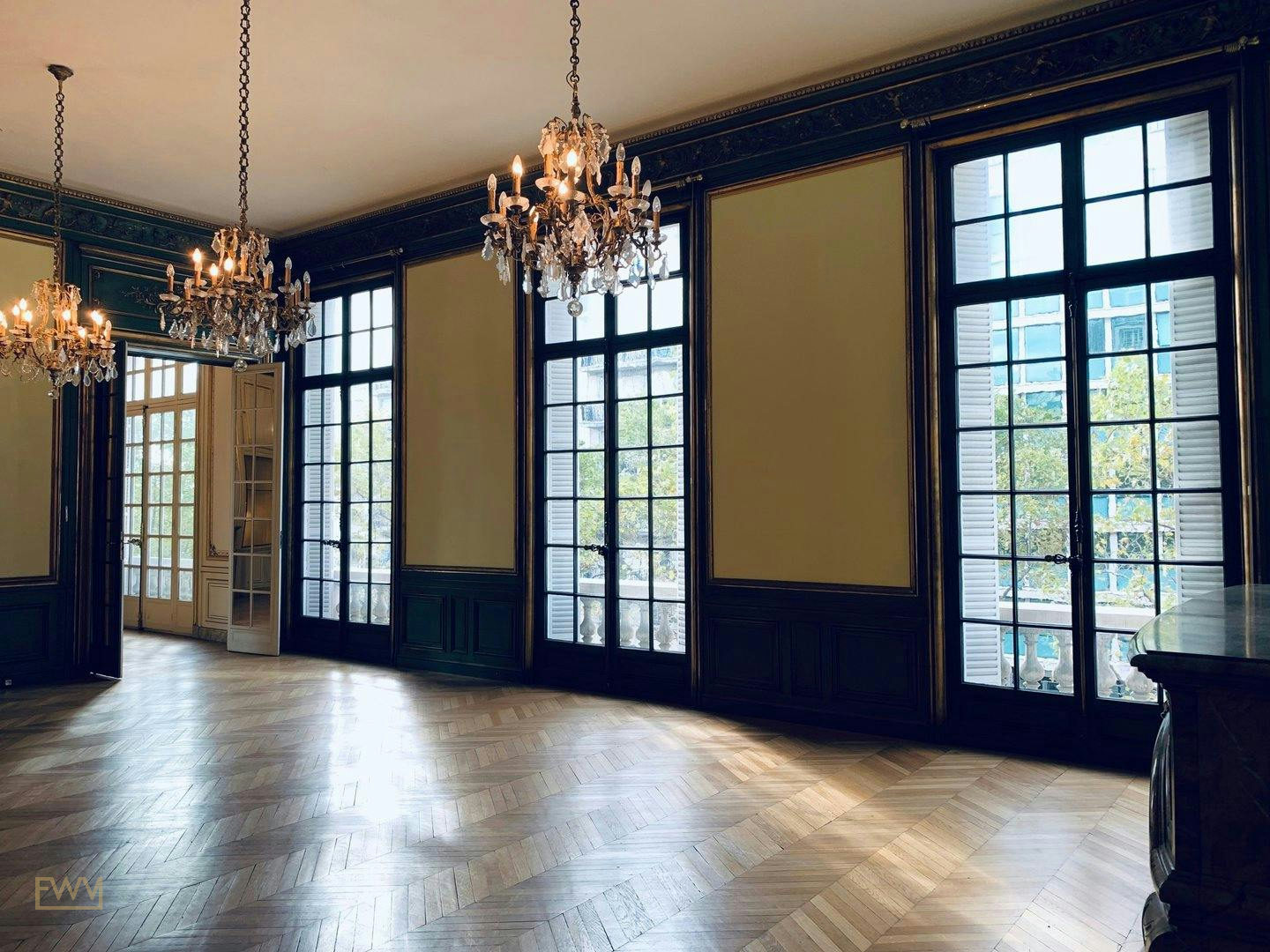
Spaces in Haussmannian buildings along and adjacent to the Champs-Élysées offer high ceilings, original parquet floors, ornate mouldings, large windows, and the architectural gravitas that many luxury brands seek for showroom events, press presentations, and VIP sales appointments. These spaces are particularly well suited to fashion and jewellery showrooms, beauty brand launches, and invitation-only retail experiences.
Hotel Suites, Event Spaces, and Meeting Rooms
The Champs-Élysées district contains several of Paris's most renowned palace hotels and luxury properties, which offer hotel room hire, event suites, luxurious rooms with terraces, and meeting rooms with full audiovisual equipment, fibre optic internet, Wi-Fi connection, and access to wellness rooms and outdoor areas. La Maison Champs-Elysées, the private mansion turned boutique hotel on Avenue Octave Homberg just off the main avenue, exemplifies the type of property that blurs the line between hospitality and brand activation venue. Its salons, garden, and rooms have been used for seminars, brand presentations, press events, and private retail experiences by fashion and luxury brands.
Hotel spaces in this district also appeal to brands needing flexible commercial formats. A hotel meeting room or suite hired for a day or a week operates under hospitality contracts rather than commercial lease law, which simplifies the engagement process considerably while still delivering address prestige and a high-quality physical environment for clientele.
Business Centres and Coworking Spaces
The Champs-Élysées and its immediate surroundings have seen growth in premium business centre and coworking formats, catering to international companies establishing a temporary Paris presence. These spaces typically offer renting offices on flexible terms, with access to a business center, shared reception, suites, and all connectivity infrastructure including fibre optic internet. While coworking environments are less suited to consumer-facing retail, they serve brand teams needing operational bases during fashion week or extended seasonal activations, and some premium formats include private salons that can support small-scale client meetings.
Commercial Space Adjacent to 92 Avenue des Champs-Élysées and Nearby Addresses
Specific addresses along the avenue, including the 92 Avenue des Champs-Élysées corridor and the blocks between Avenue Franklin Roosevelt and the Étoile, represent the commercial spine of the district. Property at these addresses tends to be held by institutional investors and managed by professional property management companies. Commercial real estate listings for these properties appear sporadically on platforms including LoopNet, CoStar, and local French commercial property sites, but the most actionable availability comes through direct broker relationships and specialist agencies with knowledge of the local market.
KEY TAKEAWAY: The Champs-Élysées offers retail, showroom, hotel, office, and coworking formats across a range of price points and lease structures. Matching the space type to the brand objective, timeline, and legal appetite is as important as selecting the right address.
The legal and contractual framework governing each space type is the subject of the next section, as this dimension is consistently where brands encounter the most significant complexity when renting in Paris.
Legal Frameworks for Renting Commercial Space in the Champs-Élysées District
Understanding the legal structure of your rental agreement before entering negotiations is essential when renting retail space in Paris. French commercial property law creates distinct categories of occupancy, and the obligations, protections, and risks attached to each category differ significantly. Brands that approach Paris real estate as if it functioned like a straightforward Anglo-American lease process routinely encounter delays, unexpected obligations, and compliance issues.
The Bail Commercial and Why It Matters
A bail commercial, or commercial lease, in France is a heavily regulated instrument that provides tenants with significant protections, including a default nine-year minimum term, a right to renewal, and caps on rent review. While these protections favour established businesses with long-term commitments, they create significant complications for brands seeking short-term retail activations. A landlord entering a standard bail commercial with a brand for a pop-up period risks creating long-term obligations they did not intend, and most landlords of premium commercial space on the Champs-Élysées are acutely aware of this risk. As a result, genuine short-term retail access to premium space on the avenue typically requires alternative legal structures.
The Bail Dérogatoire: Short-Term Commercial Occupancy
The bail dérogatoire, also known as a short-term commercial lease, allows landlord and tenant to agree a rental period of up to thirty-six months without triggering the protections and obligations of a standard bail commercial. This instrument is the legal mechanism most commonly used for pop-up retail, seasonal boutiques, showroom activations, and temporary flagships in Paris. Critically, both parties must expressly agree in writing before occupancy commences that the bail dérogatoire applies. If the tenant remains in occupation after the agreed term without a new agreement, the occupancy risks converting automatically to a standard bail commercial, creating exactly the long-term obligations the arrangement was designed to avoid.
Requirements for a valid bail dérogatoire, and the precise conditions under which it applies, vary by space type, intended use, and the specific terms negotiated. Brands should verify the structure with a qualified French commercial property lawyer before signing any agreement.
Autorisation d'Occupation Temporaire for Public Spaces
An Autorisation d'Occupation Temporaire, commonly referred to as an AOT, is the mechanism through which temporary commercial use of public or semi-public space is permitted by a French authority. AOTs are relevant where a brand wishes to activate in a publicly owned building, a protected monument forecourt, a public garden adjacent to the avenue, or a space managed by a public institution. The Grand Palais, for example, operates event space bookings through a managed booking process that involves permissions from the institution itself, often in conjunction with the broader regulatory framework for temporary commercial occupancy. AOT applications require advance notice, often several months, and approval is not guaranteed. The permit guidance tool on Fashion Week Venues provides directional orientation for brands navigating this process, though all permit applications should be verified with a French legal advisor.
Additional Compliance Considerations
Beyond the core lease structure, brands renting commercial space in the 8th arrondissement must consider several additional compliance dimensions. Paris fire safety regulations (ERP classifications) govern the maximum occupancy and safety requirements for spaces receiving the public. Temporary retail activations in residential buildings or mixed-use Haussmannian properties may require change-of-use notifications. Brands intending to use outdoor areas, terraces, or pavement frontage for retail display require separate authorisation from the City of Paris. Signage and window display regulations in the 8th arrondissement are enforced by the local mairie and by the Architectes des Bâtiments de France for protected streetscapes.
IMPORTANT: None of the information in this section constitutes legal advice. Requirements vary significantly by space, intended use, duration, and specific arrondissement regulations. All brands should obtain independent legal advice from a French commercial property specialist before entering any rental commitment.
KEY TAKEAWAY: The bail dérogatoire is the primary legal instrument enabling short-term retail activation in Paris without triggering long-term commercial lease obligations. Understanding its conditions and limitations before negotiating any space is essential for brand protection.
With the legal framework established, the next section examines how real estate platforms and specialist agencies fit into the space discovery and booking process on the Champs-Élysées.
Real Estate Platforms, Listings, and How Brands Actually Find Space on the Champs-Élysées
The commercial real estate information ecosystem for the Champs-Élysées spans international platforms, local French property networks, specialist short-term space marketplaces, and off-market broker relationships. Understanding which source serves which purpose is important for any brand conducting a serious property search in the district.
International Commercial Property Platforms
Platforms such as LoopNet and CoStar aggregate commercial real estate listings across global markets, including Paris. These platforms allow users to filter by property type, location, price range, and size, and offer functionality including saved searches, email alerts, and listing photographs. For brands beginning a high-level market survey of commercial space in the 8th arrondissement, these platforms can provide useful orientation data, including rent range benchmarks, available footage, and landlord information.
However, the most premium and most time-sensitive commercial space on the Champs-Élysées is rarely represented comprehensively on these platforms. Listings for flagship-grade retail on the avenue itself tend to appear sporadically, often represent spaces that have already been committed, or require users to register, login, create a password, agree to terms of use, and navigate platform-specific search and selection tools. Blue Listings on LoopNet, for example, represent premium placement by brokers but do not guarantee current availability or suitability for short-term activation use cases.
CoStar, which owns LoopNet, provides deeper market intelligence and investment properties data for institutional users, but access to its full dataset typically requires a broker or institutional subscription. For brand activation managers and creative directors rather than commercial real estate investment professionals, these platforms function best as research tools rather than transaction channels.
French Local Property Networks and IAD Agents
The French commercial property market operates through a network of local property agents, including independent agents affiliated with networks such as IAD, and specialist commercial brokers with deep relationships in specific arrondissements. An iad agent with a track record in the 8th arrondissement will have access to off-market opportunities, landlord relationships, and early awareness of spaces becoming available that do not appear in any public database. For brands with a specific brief and timeline, engaging a local property agent with Champs-Élysées district expertise is often the most effective first step after establishing the brand's legal entity or representation in France.
Broker professionals in the Paris commercial market typically operate on commission structures paid by the landlord, the tenant, or both parties, depending on the transaction type. Understanding the commission structure and confirming it in writing before engaging any broker is advisable.
Specialist Short-Term Space Marketplaces
For brands pursuing pop-up retail, showroom, or event space rather than a long-term commercial lease, specialist short-term space marketplaces provide a more directly relevant search environment. These platforms curate spaces specifically suited to temporary brand activations, with pre-negotiated flexible terms, clearly presented specifications, and direct booking or inquiry functionality. The Fashion Week Venues space marketplace operates in this category, offering brands a curated selection of spaces across Paris and other fashion capitals with formats tailored to short-term retail and event activation needs.
Quick answer: For brands wanting to rent retail space on the Champs-Élysées, the most efficient route typically combines an initial survey of commercial property listing platforms for market context, engagement with a local property agent for off-market access, and use of a specialist short-term space marketplace for pop-up, showroom, and event formats where flexible lease structures are required.
Search, Selection, and Managing Your Property Research
Effective property search in the Champs-Élysées district requires systematic selection criteria from the outset. Brands should define space size requirements, required frontage type, ground floor versus upper floor preference, proximity to specific metro station access, lease duration, permitted use, and budget before beginning outreach. Creating saved searches on commercial property platforms, setting up email alerts for new listings matching your criteria, and maintaining a comparison log of spaces under consideration all reduce the risk of missing time-sensitive availability.
For brands coordinating space searches with fashion week calendars or seasonal activation windows, the timeline pressure adds additional complexity. Spaces that align with Paris Fashion Week windows are typically committed months in advance, making early engagement with brokers and platforms essential.
KEY TAKEAWAY: No single platform or channel captures the full picture of commercial space availability on the Champs-Élysées. A multi-channel search strategy combining listing platforms, local broker relationships, and specialist short-term space marketplaces gives brands the most complete view of the market.
To make the most efficient use of your search, it helps to understand the specific accessibility and infrastructure characteristics of the district, which directly affect space selection decisions.
Infrastructure, Public Transport, and Accessibility Across the Champs-Élysées District
The Champs-Élysées district is exceptionally well served by Paris public transport, which is a material advantage for brands activating spaces that need to attract footfall from across the city, from central Paris hotels, and from both Charles de Gaulle and Orly airports.
Metro Access and Key Lines
The Champs-Élysées is served by metro lines 1 and 9, two of the busiest and most strategically positioned lines in the Paris network. Line 1 runs east-west across the city from Vincennes to La Défense, passing through key stations including George V, Franklin D. Roosevelt, and Champs-Élysées-Clémenceau. These stations place the avenue within a few minutes of the Marais, the Louvre, the Opera district, and the financial district at La Défense. Line 9 intersects the district at Franklin D. Roosevelt, providing connections to the south and east of the city.
The George V metro station is the primary access point for the upper Champs-Élysées, closest to the Arc de Triomphe end of the avenue and the luxury hotel cluster. The Franklin D. Roosevelt station sits mid-avenue at the Rond-Point des Champs-Élysées and is the most central access point for the commercial stretch. Champs-Élysées-Clémenceau serves the lower avenue toward the Grand Palais and the Place de la Concorde end.
For brands assessing footfall patterns from a retail perspective, understanding which metro station is nearest to a specific retail space helps model the likely pedestrian flow past the frontage. Spaces closest to George V metro benefit from the highest concentration of luxury hotel guest traffic. Spaces nearest Franklin D. Roosevelt capture the broadest mix of tourist and Parisian visitor flows.
Bus Routes, Vélib, and Car Access
The avenue itself is served by multiple bus lines, and the recent transformation of the Champs-Élysées urban plan has progressively reduced private car lanes in favour of pedestrianised and cycling-friendly infrastructure. This shift increases pedestrian dwell time along the commercial stretch, which is beneficial for retail activations. The expansion of the Vélib bicycle-sharing network has added further accessibility for Parisian residents approaching from adjoining arrondissements.
Proximity to Pont de l'Alma and the Seine
The Pont de l'Alma, roughly fifteen minutes on foot south of the Rond-Point des Champs-Élysées, connects the 8th arrondissement to the 7th and to the Eiffel Tower area. This positioning makes spaces in the Avenue Franklin Roosevelt and lower Champs-Élysées area accessible not only to visitors arriving by metro but also to those arriving by Bateaux Mouches river cruises, which dock at the Alma-Marceau pier. For brands targeting international tourists, proximity to this river access point represents an additional catchment advantage.
DID YOU KNOW: Paris metro lines 1 and 9, which both serve the Champs-Élysées district, collectively carry some of the highest daily passenger volumes in the entire Paris Metro network, making the avenue one of the most accessible commercial locations in continental Europe.
KEY TAKEAWAY: Infrastructure and transport access in the Champs-Élysées district is a genuine commercial asset. Brands should map the metro station proximity and pedestrian flow patterns for each space under consideration as part of the selection criteria, not as an afterthought.
To compare neighbourhoods and space types across Paris more broadly, explore the Paris city hub on Fashion Week Venues and shortlist spaces that match your brief, budget, and calendar window.
Budget Planning and Cost Structures for Renting Space on the Champs-Élysées
Renting retail or commercial space on the Champs-Élysées requires serious budget planning. The avenue sits at the premium end of Paris commercial real estate, and costs extend well beyond the base rental rate to encompass fit-out, production, staffing, logistics, permit applications, and operational expenses during the activation period.
Understanding the Rental Cost Components
The base rental rate for commercial space in the Champs-Élysées district reflects both the address premium and the specific space characteristics. Ground-floor street-facing retail commands the highest rates. Upper-floor spaces in Haussmannian buildings on the avenue itself carry a lower base rate but still reflect the address premium. Side street and adjacent avenue properties such as those on Avenue Franklin Roosevelt or the streets connecting the Champs-Élysées to Avenue Montaigne represent a step down in rent while still offering meaningful district association.
Because accurate pricing in this market is highly variable and transaction-specific, directional estimates without source attribution would be misleading. Brands planning their budgets should use dedicated planning tools and broker consultations to establish realistic cost ranges for their specific brief. The Fashion Week Venues budget estimation tool provides a starting framework for pop-up and short-term activation cost modelling.
Production, Fit-Out, and Design Costs
For temporary retail activations, the cost of transforming a raw commercial space into a branded retail environment can represent a substantial proportion of the total project budget. Production and fit-out costs in Paris depend on the complexity of the design concept, the quality of materials, the lead time available, and whether the brand is reusing modular elements from previous activations or commissioning bespoke construction. Costs in this category are highly sensitive to design ambition and operational timeline.
Furniture, AV, and Operational Equipment
Activations in the Champs-Élysées district often require premium-quality furniture, point-of-sale systems, audiovisual equipment for brand storytelling, Wi-Fi connectivity infrastructure, and operational logistics. Each of these elements adds to the total cost of activation and must be planned and sourced in advance to meet the expectations of the district's clientele and media audience.
Staffing and Ongoing Operational Costs
Staffing a retail or showroom space in one of the world's most visited commercial districts requires careful planning. Language capability, product knowledge, brand alignment, and local market familiarity are all factors in staff selection. Operational costs including security, cleaning, waste management, and utilities add to the ongoing expense during the activation period.
Quick answer: Total costs for a short-term retail activation on the Champs-Élysées extend well beyond rent and include production, fit-out, staffing, logistics, permits, and operational expenses. Brands should model the full cost picture using a comprehensive budget tool before committing to a space or timeline.
For brands wanting to model return on investment alongside costs, the ROI calculation tool on Fashion Week Venues provides a structured framework for evaluating activation value against total investment.
KEY TAKEAWAY: Budget planning for a Champs-Élysées retail activation must account for every cost layer from rental to production to staffing to logistics. Underestimating the total investment required is one of the most common causes of activation underperformance at premium Paris addresses.
Understanding how Fashion Week Venues can support brands across this full cost landscape is the subject of the next section.
How Fashion Week Venues Supports Brands Renting Retail Space on the Champs-Élysées
Fashion Week Venues operates as a full-service pop-up shop agency and space marketplace with Paris as its primary market. For brands planning to rent retail space on the Champs-Élysées or elsewhere in the 8th arrondissement, the agency provides end-to-end support across every dimension of the activation process, from initial space discovery through to post-activation analytics.
Venue Sourcing and Space Discovery
The venue sourcing service covers the identification, shortlisting, and qualification of spaces across Paris that match a brand's brief for size, format, neighbourhood, duration, and budget. For the Champs-Élysées district specifically, this service draws on established relationships with property owners, managers, and agents in the 8th arrondissement to surface options that may not appear in public listing databases. The process includes site visits, space assessment against the brand brief, and negotiation support, though brands are advised to involve their own legal counsel in any formal lease agreement.
Concept Direction and Branded Store Design
Once a space is identified, the concept direction service and branded store design service translate the brand's creative brief into a spatial concept appropriate for the space, the district, and the target audience. The design process for Champs-Élysées activations must reconcile the brand's visual identity with the physical characteristics of the space, which in Haussmannian buildings means working with high ceilings, ornate architectural details, and typically challenging natural light conditions.
Production, Build, and Fit-Out
The production and build service manages the physical transformation of the space from raw property to activated brand environment. This includes sourcing construction teams, coordinating with building management for access and noise restrictions, managing the delivery and installation of branded fixtures and displays, and ensuring compliance with building regulations and fire safety requirements applicable to the space. Production timelines for Champs-Élysées district activations must account for access restrictions during peak hours and the logistical complexity of deliveries in a high-traffic central Paris location.
Activation Management, Staffing, and Operations
During the live activation period, the activation management service coordinates the operational running of the space, managing the daily logistics of a retail or event environment. The retail staffing service provides trained, brand-aligned staff appropriate for the specific activation format, whether that is a consumer-facing pop-up, a trade showroom, a press and influencer event, or a VIP sales experience.
Tools for Planning and Decision-Making
Fashion Week Venues provides a suite of planning tools that support brands at every stage of the process. The timeline planning tool maps the lead times required for each phase of activation from initial brief to opening day. The space comparison tool enables brands to evaluate multiple spaces against each other on key criteria. The space locator tool helps brands visualise space options within the specific geography of the district.
Which Brand Teams Benefit Most
Fashion Week Venues is best positioned to support international brands entering Paris for the first time, brands with established Paris market relationships who want to scale their activation capacity, and brand activation managers who need to coordinate multiple workstreams across venue, design, production, staffing, and logistics without building an in-house Paris team. The agency's full-service model is most effective when engaged early in the planning process, ideally three to six months before the intended activation date for complex Champs-Élysées district activations.
Quick answer: Fashion Week Venues offers venue sourcing, concept direction, production, activation management, staffing, and a suite of planning tools for brands wanting to activate short-term retail or event spaces on the Champs-Élysées. The agency does not guarantee space availability, permit approval, or specific commercial outcomes.
KEY TAKEAWAY: Brands that engage Fashion Week Venues early in their planning process and provide a clear, detailed brief consistently achieve more efficient space selection, more coherent activation design, and more manageable operational delivery than those attempting to coordinate these workstreams independently.
For brands considering whether to manage their Paris activation independently or through an agency, the guide to hiring an agency on Fashion Week Venues provides a structured framework for that decision.
Calendar Strategy: Aligning Your Champs-Élysées Activation with Paris Fashion Week and Beyond
The timing of a Champs-Élysées retail or event activation is as strategically important as the choice of space. Paris operates on a global fashion and luxury calendar that creates intense seasonal peaks of media attention, buyer presence, and international visitor concentration, but also offers compelling activation opportunities throughout the year that many brands overlook.
Paris Fashion Week Windows
Paris Fashion Week occurs twice annually, with Women's Ready-to-Wear in late September and early October for the Spring/Summer season, and in late February and early March for the Autumn/Winter season. These windows concentrate the global fashion press, international buyers, major retailers, stylists, and influencers in Paris simultaneously, creating unparalleled media amplification potential for any brand activation in the city. The Champs-Élysées district, with its Grand Palais shows and proximity to the Triangle d'Or, sits at the geographical heart of Fashion Week activity.
Spaces during Paris Fashion Week windows book out many months in advance. Brands that begin their search fewer than four months before their target fashion week window frequently encounter very limited availability in the Champs-Élysées district specifically.
Paris Haute Couture and Men's Fashion Week
In addition to the main Women's ready-to-wear calendar, Paris hosts Haute Couture Week in January and July, and Men's Fashion Week in January. These calendars attract a more concentrated but extremely high-value audience of press, buyers, and high-net-worth consumers, and create activation opportunities for brands targeting these specific market segments.
Seasonal and Event-Driven Windows Beyond Fashion Week
Many brands treat Paris Fashion Week as the only viable activation window, which is a common strategic error. The Champs-Élysées maintains strong international footfall and media interest throughout the year. The Christmas and New Year period, the summer tourist peak from June through August, and the spring high season from April through June all represent significant activation opportunities. Major events at the Grand Palais, including FIAC and other international art fairs, draw an affluent and culturally engaged international audience to the district outside fashion week periods.
KEY TAKEAWAY: Paris Fashion Week creates the highest density of media and trade attention, but the Champs-Élysées sustains premium footfall and international visitor concentration across multiple seasonal windows throughout the year. Brands willing to activate outside peak fashion week periods often find better space availability, more competitive rental terms, and higher consumer dwell time.
Common Myths About Renting Retail Space on the Champs-Élysées
MYTH: You need a French legal entity to rent commercial space on the Champs-Élysées.
FACT: International brands can rent commercial space in Paris without a fully established French legal entity in many short-term activation scenarios. The legal mechanism, including the bail dérogatoire for temporary commercial leases, can be structured with foreign entities in certain circumstances. However, specific requirements vary by landlord, space type, and intended use, and obtaining qualified French legal and commercial advice before proceeding is essential. Some landlords do require a French entity or local guarantor, making early legal planning a practical necessity.
MYTH: Paris Fashion Week is the only valuable calendar window for a Champs-Élysées activation.
FACT: The Champs-Élysées district sustains high international visitor volumes across the entire year, with the summer tourist season, the Christmas and New Year period, and major events at the Grand Palais all representing commercially significant windows. Brands activating outside fashion week often benefit from better space availability, more competitive rental terms, and a consumer audience that is not simultaneously competing with dozens of other brand activations for attention.
MYTH: Commission brokers are the only way to access premium space on the Champs-Élysées.
FACT: While established broker relationships do provide meaningful access to off-market and premium space availability, specialist short-term space marketplaces and full-service agencies such as Fashion Week Venues offer alternative access routes specifically designed for pop-up and temporary activation formats. These routes can be more efficient for brands with clear short-term briefs and are often better suited to the legal structure and timeline of a temporary activation than a traditional commercial broker transaction.
MYTH: Short-term leases in Paris are legally straightforward and require no specialist advice.
FACT: Short-term commercial leases in France, including the bail dérogatoire, are governed by specific legal conditions that, if not correctly implemented, can create unintended long-term obligations for both landlord and tenant. The automatic conversion risk from a bail dérogatoire to a standard bail commercial if the tenant remains in occupation beyond the agreed term is a real and material legal risk. Specialist French commercial property legal advice is not optional for brands entering into any form of commercial rental agreement in Paris.
MYTH: Any space listed on LoopNet or CoStar as available in the 8th arrondissement can be used for a pop-up retail activation.
FACT: Commercial property listings on general platforms do not specify the permitted use, ERP classification, fire safety capacity, or lease structure flexibility of the listed space. A space listed for commercial use may not have planning permission for consumer-facing retail, may not meet the fire safety requirements for temporary public events, or may be subject to a minimum lease term incompatible with a short-term activation. Verifying all of these dimensions before entering negotiations is essential.
Frequently Asked Questions
What is the process for renting retail space on the Champs-Élysées for a short-term brand activation?
The process typically begins with defining the activation brief, including required space size, format, duration, budget, and intended use. This is followed by a market search combining platform listings, broker outreach, and specialist marketplace discovery. Once shortlisted spaces are identified, site visits and qualification against the brief occur before lease negotiation and legal review. Production and fit-out planning runs in parallel with lease finalisation. For complex activations in the Champs-Élysées district, the full process from brief to opening typically requires a minimum of three to six months of planning lead time, and sometimes longer for premium frontage positions.
Do I need a French company to rent space on the Champs-Élysées?
Not in every case. Many short-term commercial space arrangements can be structured with foreign legal entities, particularly for bail dérogatoire formats and hotel or hospitality venue hire. However, individual landlords in the Champs-Élysées district have varying requirements, and some do require a French entity or local guarantor. The specific requirements for your activation should be confirmed with a qualified French commercial property lawyer and with the relevant landlord or their agent before committing to a space. Early legal planning is strongly advisable to avoid delays once a preferred space is identified.
What is the difference between a bail dérogatoire and a standard commercial lease in Paris?
A standard bail commercial in France provides tenants with substantial protections including a default nine-year minimum term and a right to lease renewal, which makes it unsuitable for short-term brand activations. A bail dérogatoire is an alternative structure allowing occupancy for up to thirty-six months without triggering the protections of a standard commercial lease. Both parties must expressly agree in writing before occupancy that a bail dérogatoire applies. If the tenant remains in the space after the agreed term without a new agreement, there is a risk the occupancy converts to a standard bail commercial. Specialist legal advice is essential before using either structure.
Why should my brand choose the Champs-Élysées district over other Paris neighbourhoods for a retail activation?
The Champs-Élysées district offers the combination of international name recognition, concentrated luxury footfall, media amplification potential, and architectural prestige that no other Paris neighbourhood replicates at the same scale. It is particularly effective for brands targeting international consumers, building global brand awareness, generating press and influencer coverage, and communicating a luxury or premium positioning. It is a less suitable choice for brands targeting local Parisian consumers primarily, or for activations where space costs need to be kept very low relative to the market average for premium Paris addresses.
How far in advance should I start looking for space on the Champs-Élysées for Paris Fashion Week?
For Paris Fashion Week windows specifically, brands should begin their space search a minimum of four to six months in advance of the target window. Premium spaces in the Champs-Élysées district and the wider 8th arrondissement are committed well ahead of the calendar peak, and brands beginning their search fewer than three months before Paris Fashion Week typically find that the most desirable spaces are already taken. Earlier engagement also provides more time for legal review, production planning, and permit applications, all of which have lead times that compound quickly in a compressed timeline.
What types of permits or authorisations are needed for a temporary retail pop-up on the Champs-Élysées?
The specific permits required depend on the space type, intended use, duration, and specific location. Temporary consumer-facing retail typically requires compliance with ERP fire safety classifications and may require notification to or approval from the local mairie. Activations using outdoor areas, terraces, or pavement frontage require separate authorisation from the City of Paris. Activations in publicly owned or managed venues require an Autorisation d'Occupation Temporaire. Signage and window display in the 8th arrondissement may require approval from the Architectes des Bâtiments de France. Requirements should be verified with a French legal advisor and with the relevant city authority well in advance of the planned activation date.
Can a hotel room or event suite on the Champs-Élysées be used for a brand retail or showroom activation?
Hotel room hire and event suite rental in the Champs-Élysées district is used by fashion and luxury brands for showroom events, press presentations, VIP sales appointments, and invitation-only retail experiences. These formats operate under hospitality contracts rather than commercial lease law, which simplifies the legal engagement considerably while still delivering the address prestige and quality environment expected by premium clientele. Spaces such as those at La Maison Champs-Elysées, with their luxurious rooms, terraces, and outdoor areas, have been used for precisely these brand activation purposes, and several hotels in the district offer meeting rooms and suites with audiovisual equipment, fibre optic internet, and Wi-Fi connection suited to both commercial and creative brand uses.
What does a typical Champs-Élysées retail activation cost, and how should I estimate my budget?
Total activation costs in the Champs-Élysées district extend well beyond the base rental rate and include production, fit-out, branded store design, furniture rental, staffing, logistics, point-of-sale systems, connectivity infrastructure, permit applications, legal fees, and operational expenses during the live period. Because costs are highly variable based on space size, design complexity, duration, and specific space characteristics, directional estimates without source-specific data would be misleading. Brands should use a structured budget planning tool and obtain broker-provided rental benchmarks for their specific brief before establishing a budget. The Fashion Week Venues budget estimation tool provides a useful starting framework for modelling total activation costs.
What is the best area within the Champs-Élysées district for a luxury brand pop-up?
The optimal area depends on the brand's specific objectives and target audience. The upper Champs-Élysées, toward the Arc de Triomphe and the George V metro, is closest to the luxury hotel cluster and captures the highest concentration of high-net-worth international visitors. The mid-avenue stretch around the Rond-Point des Champs-Élysées and Avenue Franklin Roosevelt offers the broadest mixed footfall. Side streets such as those connecting the main avenue to Avenue Montaigne offer a quieter, more curated environment suited to showroom and VIP formats. The area toward Pont de l'Alma and the Balzac quarter provides premium 8th arrondissement positioning with somewhat lower base rental rates than the main avenue.
How does metro access affect space selection on the Champs-Élysées?
Metro lines 1 and 9 serve the Champs-Élysées district through the George V, Franklin D. Roosevelt, and Champs-Élysées-Clémenceau stations. Proximity to a specific metro station affects the pedestrian flow pattern past a retail frontage and the ease with which staff, press, buyers, and consumers can access the space. Spaces closest to George V metro tend to see more hotel-based luxury visitor traffic. Spaces nearest Franklin D. Roosevelt capture the broadest tourist and Parisian mix. For activations relying on footfall rather than invitation-only audiences, metro proximity is a material factor in space selection rather than a secondary consideration.
Can I use platforms like LoopNet or CoStar to find short-term pop-up spaces on the Champs-Élysées?
LoopNet and CoStar can provide useful market context and broad availability data for commercial real estate in the Champs-Élysées district, but they are not optimised for short-term pop-up or event space discovery. Most premium short-term activation spaces are not listed on these general commercial property platforms, and those that do appear may not have confirmed availability or may be listed with terms suited to longer-term commercial occupancy. Specialist short-term space marketplaces, combined with local broker relationships and specialist agency support, are more effective channels for discovering and securing short-term retail and event spaces in the district.
What amenities should I expect in a premium commercial space on the Champs-Élysées?
Premium commercial spaces in the Champs-Élysées district vary significantly in their included amenities depending on the space type and landlord. Hotel event spaces and business centres typically offer fibre optic internet, audiovisual equipment, Wi-Fi connection, access to meeting rooms, reception services, and in some cases wellness rooms, terraces, and outdoor areas. Standalone commercial units in Haussmannian buildings or street-level retail typically require brands to supply and install all operational infrastructure. The specification of included versus excluded amenities should always be confirmed in writing as part of the space agreement before occupancy.
How do I manage a saved search or set up alerts for new Champs-Élysées commercial listings?
Commercial property platforms including LoopNet allow registered users to save searches, set up email alerts for new listings matching their criteria, and manage their search history through a logged-in account. To use these features, users typically need to complete a login process, create a password, and agree to the platform's Terms of Use and associated Google Privacy Policy and Terms of Service if reCAPTCHA security is used on the platform. Saved searches and email alerts are useful tools for monitoring evolving availability in a fast-moving market. However, for the most time-sensitive Champs-Élysées opportunities, supplementing platform alerts with direct broker and agency contact is advisable, as the most premium spaces often do not appear in public listings at all.
What does Fashion Week Venues offer that a traditional commercial property broker does not?
Traditional commercial property brokers specialise in lease transactions, typically on standard or long-term commercial lease terms, and their expertise and incentives are aligned with transaction completion rather than operational activation success. Fashion Week Venues offers a full-service model that covers not only space discovery but also concept direction, production, branded store design, activation management, staffing, point-of-sale systems, data and analytics, and influencer marketing. For brands wanting a single agency to coordinate all workstreams of a Paris retail activation, this integrated approach reduces the coordination burden significantly compared to managing separate vendors for each service area. The two models serve different needs and are not mutually exclusive.
Is the Champs-Élysées district suitable for brands that are not yet established in the luxury tier?
The Champs-Élysées district is associated strongly with luxury and premium positioning, but it is not exclusively reserved for established luxury maisons. Contemporary brands, premium lifestyle labels, international high-street brands with flagship ambitions, and emerging designer labels have all activated successfully in the district. The key consideration is whether the address investment is proportionate to the brand's commercial objectives and budget. For brands for whom the address premium is a strategic investment in brand positioning and media reach rather than a purely transactional retail decision, the Champs-Élysées district can deliver outsized value relative to the cost, regardless of the brand's price tier.
Conclusion: Making Your Champs-Élysées Retail Activation a Success
The decision to rent retail space on the Champs-Élysées is one of the highest-visibility commercial moves available to any fashion, luxury, or premium brand operating internationally. The avenue's combination of architectural prestige, landmark context, international footfall, media amplification potential, and cultural authority creates a unique commercial environment that no other address in Paris or any other European city fully replicates.
Executing a successful Champs-Élysées activation requires expertise across multiple disciplines simultaneously: commercial property sourcing, French legal compliance, spatial design, production management, operational logistics, staffing, and marketing. Each of these dimensions carries material complexity, and underestimating any one of them is the most common cause of activation underperformance at this address tier.
The most effective brand teams approach Champs-Élysées activations with a clear brief, a realistic budget that accounts for the full cost picture rather than just rental, a timeline that allows for proper legal review and production planning, and either a strong internal team with Paris market expertise or a specialist agency partner who can provide that expertise in their place.
Fashion Week Venues provides the integrated agency support, space marketplace access, and planning tools that brands need to navigate this process with confidence. Whether you are planning your first Paris activation or expanding an established market presence, the combination of venue sourcing, full-service production, and activation management available through Fashion Week Venues is designed to reduce the coordination burden and increase the quality of the final activation.
To move from research to activation, start exploring available spaces on the Fashion Week Venues marketplace and build a focused brief for your target neighbourhood, space type, and calendar window. The earlier you engage with the market, the broader your options and the stronger your negotiating position on both space and terms.