Short term retail in the 16th arrondissement Paris offers fashion brands, luxury labels, and international activators access to one of the city's most prestigious and architecturally distinctive neighbourhoods. From the grand Haussmannian boulevards near Trocadéro to the quieter village streets of Passy and Auteuil, Paris 16 combines affluent residential density with iconic cultural landmarks, making it a compelling but often underestimated canvas for pop-up shops, showrooms, and brand activations. This guide covers the neighbourhood in detail, explains which streets and sub-zones attract different brand profiles, and outlines the practical logistics of securing and operating a short-term retail space. Fashion Week Venues supports brands at every stage of this process, from space discovery to full activation management.
What Is the 16th Arrondissement and Why Does It Matter for Retail?
The 16th arrondissement, known locally as Paris 16, occupies the western edge of Paris along the Seine, stretching from the Arc de Triomphe and Champs-Élysées border in the north to the Bois de Boulogne and Auteuil Villas in the south. It is one of Paris's largest and most affluent arrondissements, characterised by wide Haussmannian boulevards, ornate apartment buildings, Art Nouveau architecture by Hector Guimard, and a density of museums, parks, and cultural institutions that few Parisian districts can rival.
For retail and brand activation purposes, the 16th arrondissement is best understood as several distinct micro-zones, each with its own character, footfall profile, and suitability for different types of short-term retail. Trocadéro and the area around Place du Trocadéro draws enormous tourist and cultural traffic, anchored by the Palais de Chaillot, the Palais de Tokyo, and the direct sight line to the Tour Eiffel. Passy and Rue de Passy offer a more residential but commercially active high street, lined with independent boutiques, the Passy Plaza shopping centre, and strong local spending power. Auteuil provides a quieter, more village-like atmosphere, beloved by long-term Parisian residents, with streets like Rue de l'Annonciation delivering genuine neighbourhood retail character.
The arrondissement is bordered to the east by the Champs-Élysées corridor and the triangle d'or, making it adjacent to some of the most expensive luxury retail in Europe. Avenue Victor Hugo and Rue Kleber serve as major north-south arteries connecting the Arc de Triomphe area to the quieter southern reaches of the 16th. The Seine forms the western and southern boundary, with Port de Saint Cloud and Avenue de Versailles running along the river. To the west lies the Bois de Boulogne, Paris's largest park, which contains the Jardin d'Acclimatation, the Fondation Louis Vuitton designed by Frank Gehry, and the Parc de Bagatelle.
Culturally, the 16th is home to an extraordinary concentration of museums: the Musée Marmottan Monet, which holds the world's largest collection of Claude Monet's works; the Maison de Balzac, dedicated to the writer Honoré de Balzac and tucked onto the quietly remarkable Rue Berton; the Musée Clemenceau; and the Musée du Vin. The Palais de Tokyo, one of Europe's largest centres for contemporary art, draws a creative and fashion-literate audience that is directly relevant to brand activation briefs. The Fondation Louis Vuitton has elevated the arrondissement's profile further as a destination for global art and fashion audiences since its opening.
For short-term retail operators, these cultural anchors matter because they generate consistent visitor flows from a high-spending, culturally engaged demographic. A pop-up store or showroom positioned within walking distance of the Trocadéro or along Rue de Passy can benefit from foot traffic that would cost a brand significantly more to attract in a pure media campaign.
Quick answer: The 16th arrondissement Paris is a large, wealthy, and culturally rich district on the city's western edge, encompassing areas like Trocadéro, Passy, Chaillot, and Auteuil. It offers short-term retail operators a combination of affluent residential spending, strong tourist footfall near key landmarks, and proximity to world-class cultural institutions, making it a strategically valuable neighbourhood for luxury, fashion, and lifestyle brands.
KEY TAKEAWAY: Paris 16 is not a single retail environment but a collection of distinct micro-zones, each with different footfall profiles, audience demographics, and suitability for different types of short-term retail activation. Understanding this internal geography is essential before committing to a space.
With the neighbourhood's geography established, the next question is which specific streets, sub-zones, and space types are most relevant for different kinds of retail activations.
Key Streets and Sub-Zones for Short Term Retail in Paris 16
The 16th arrondissement's retail geography divides into several distinct zones, each with its own advantages for brands considering short term retail space in Paris. Choosing the right sub-zone depends on your target audience, brand positioning, activation format, and budget.
Trocadéro and Chaillot
The Trocadéro area, centred on Place du Trocadéro and the Palais de Chaillot, is arguably the most internationally recognised zone within Paris 16. The direct view of the Tour Eiffel from the Trocadéro terraces makes this one of the most photographed spots in the world and an area of enormous tourist density. Spaces in this zone attract premium rents even for short-term agreements, but the audience reach is unmatched for brands targeting international visitors, luxury tourism, and social media amplification. Showrooms and pop-up stores positioned near Trocadéro benefit from proximity to the Palais de Tokyo and its culturally sophisticated visitor base.
Passy and Rue de Passy
Rue de Passy is the commercial spine of the arrondissement for local residents. It is a lively and accessible high street served by the Passy metro station, lined with boutiques, cafes, and the Passy Plaza centre. This zone is distinctly different from Trocadéro: it is more residential, more local, and more focused on day-to-day spending by affluent Parisian households. Short-term retail here benefits from repeat-visit potential, strong word-of-mouth among local residents, and a slightly more approachable positioning than the grand tourist zones. Rue de l'Annonciation, running south from Rue de Passy toward Auteuil, is particularly well-regarded for independent retail and artisan businesses.
Auteuil and the Southern Villages
The southern sections of the 16th, including Auteuil, the Auteuil Villas, Villa Montmorency, and the Hameau Boileau, offer a genuinely village-like atmosphere that is unusual for a major Parisian arrondissement. These areas are predominantly residential but attract visitors interested in the Art Nouveau architecture of Hector Guimard, the Roland Garros Stadium and the French Open tennis tournament, and the Stade Jean-Bouin nearby. Brands with a lifestyle, sportswear, or architectural positioning may find this zone particularly compelling. The Parc des Princes and the broader sporting identity of the southern 16th add an additional audience layer during event periods.
Avenue Victor Hugo and Rue Kleber
Avenue Victor Hugo is one of the great residential boulevards of Paris 16, running south from the Arc de Triomphe area. It hosts a strong mix of upscale boutiques, independent retailers, and apartment-level showrooms. Rue Kleber connects the Arc de Triomphe directly to Trocadéro, making it a high-traffic artery. Both streets offer Haussmannian buildings with high-ceilinged ground floor commercial spaces that work well as boutique pop-ups or temporary galleries. Brands positioning themselves as premium or aspirational Parisian often find Avenue Victor Hugo a credible and photogenic location.
Bois de Boulogne and the Western Edge
The Bois de Boulogne is not a retail zone in the conventional sense, but it hosts some of Paris's most remarkable event and activation venues. The Fondation Louis Vuitton, the Jardin d'Acclimatation, and the Parc de Bagatelle all sit within or adjacent to the Bois, and brands with sufficient scale and budget can explore activation partnerships or temporary installations in this area. The Port de Saint Cloud and Avenue de Versailles on the southern edge of the 16th also offer river-adjacent spaces including péniches (barge venues) moored along the Seine.
DID YOU KNOW: The Jardin du Ranelagh, a formal park in the centre of the 16th arrondissement near the Chau. de la Muette, is popular with local families and offers a quiet, residential character that contrasts sharply with the tourist intensity of Trocadéro just a few blocks away.
| Sub-Zone | Primary Audience | Best Space Types | Brand Positioning Fit |
|---|---|---|---|
| Trocadéro / Chaillot | International tourists, cultural visitors | Pop-up store, showroom, galerie | Luxury, heritage, flagship |
| Rue de Passy / Passy Plaza | Affluent local residents | Boutique, local commercial, storefront | Premium lifestyle, contemporary fashion |
| Avenue Victor Hugo / Rue Kleber | Parisian professionals, aspirational shoppers | Haussmannian boutique, appartement showroom | Aspirational, heritage, niche luxury |
| Auteuil / Southern Villages | Residents, sports visitors, architecture enthusiasts | Studio, concept space, small boutique | Lifestyle, sportswear, artisanal |
| Bois de Boulogne / Seine riverside | Event audiences, cultural visitors | Péniche, outdoor activation, event space | Experiential, luxury event, art-fashion crossover |
KEY TAKEAWAY: Different sub-zones within the 16th serve very different retail briefs. Trocadéro maximises tourist reach and media potential, while Passy and Auteuil offer genuine local residential audiences. Brands should match their sub-zone choice to their primary audience and activation objective before shortlisting spaces.
Understanding the neighbourhood's internal geography sets the foundation for making sound decisions about space type, lease structure, and operational logistics, which are covered in the next section.
Types of Short Term Retail Spaces Available in the 16th Arrondissement
The 16th arrondissement offers a diverse range of space formats suitable for short-term retail, from compact boutique storefronts to grand Haussmannian apartments, floating péniches on the Seine, and contemporary studios used for photo and film production as well as direct retail. Understanding which space type fits your activation format is as important as choosing the right street.
Quick answer: Short-term retail spaces in the 16th arrondissement Paris include boutique storefronts, appartements Haussmanniens, galeries, local commercial units, showrooms, studios, péniches, conference and event halls, and outdoor terrace spaces. The right format depends on the brand's activation objectives, budget, desired audience, and the specific micro-zone within Paris 16.
Boutique Storefronts and Local Commercial Units
Ground floor commercial spaces, known in French as local commercial units, are the most conventional short-term retail format in the 16th. These range from compact single-room boutiques of 20 to 40 square metres on Rue de l'Annonciation to larger corner storefronts on Avenue Victor Hugo. They offer direct street-level visibility and are the most recognisable retail format for brands launching a pop-up store. Lease terms for short-term use are typically structured as bail dérogatoire agreements, which we cover in detail in the permits and legal section below.
Appartements Haussmanniens
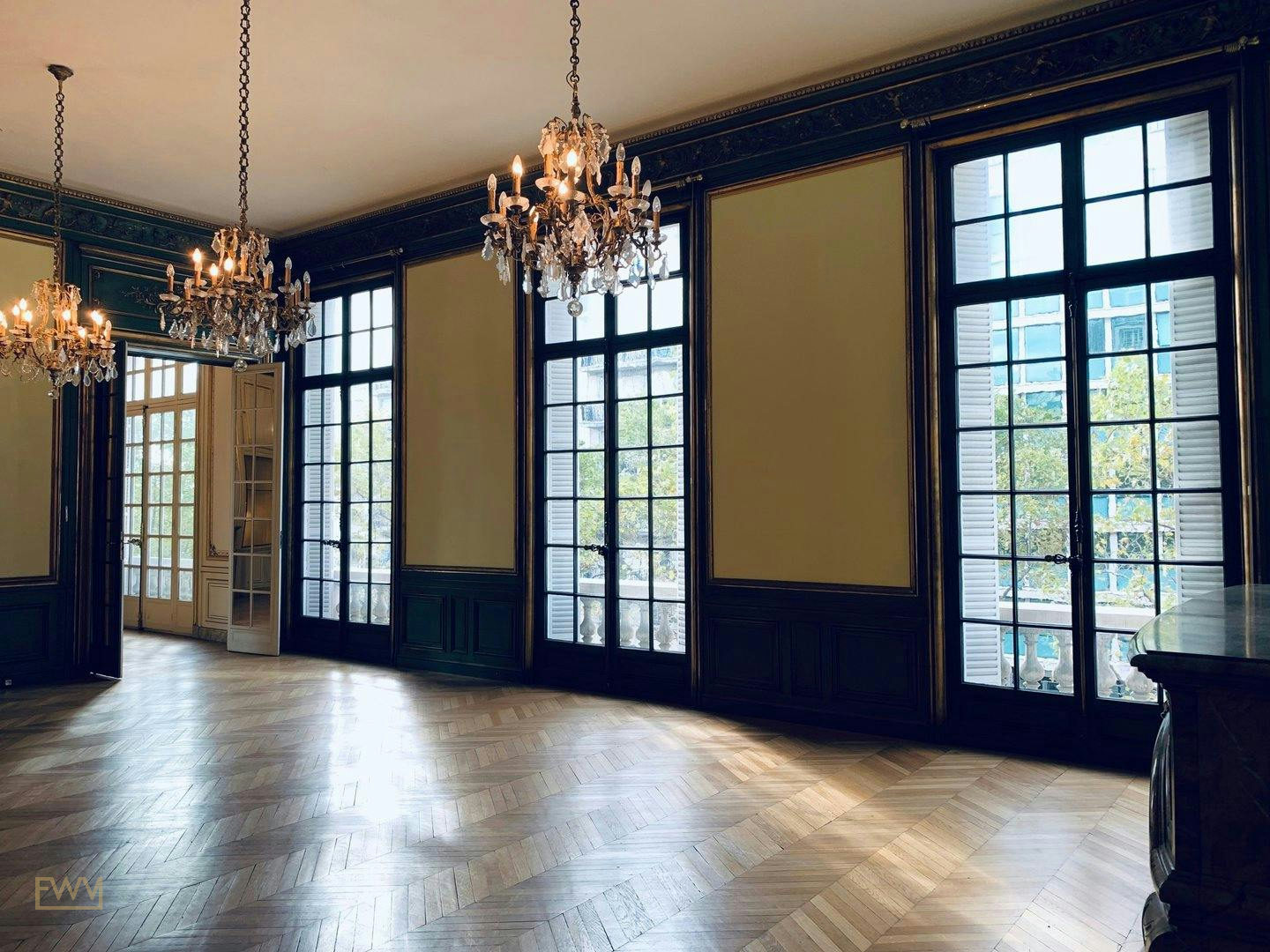
One of the most distinctive and sought-after space formats in the 16th is the luxury architecturally-designed Haussmannian apartment used as a retail or showroom space. These high-ceilinged, ornately detailed apartments, common along Avenue Victor Hugo, Avenue de Versailles, and the boulevards surrounding Trocadéro, provide an extraordinary setting for fashion showrooms, private sales, press presentations, and immersive brand experiences. An appartement Haussmannien as a retail space gives brands an intimate, curated feeling that a conventional storefront cannot replicate. They are particularly popular with fashion houses, perfume brands, and luxury lifestyle labels.
Galeries and Boutique Galeries
The 16th has a strong tradition of art galleries, and a number of these spaces can be hired short-term for retail activations with an art-fashion crossover positioning. Boutique galeries offer a hybrid retail-exhibition format that aligns well with the arrondissement's cultural identity, particularly near the Palais de Tokyo and the Fondation Louis Vuitton. Brands in fashion, jewellery, and design often find galerie formats effective for building brand credibility alongside direct commerce.
Studios for Photo, Film, and Retail
Studio spaces designed for photography and film production are increasingly used by fashion brands as dual-purpose spaces: production during weekdays and retail or brand experience during consumer-facing event days. Several studio spaces in the 16th, particularly in the southern Auteuil zone, offer flexible configurations that work across both functions. A Studio Photo et Tournage can serve as a campaign production base and a consumer activation venue within the same short-term lease.
Péniches on the Seine
Péniches, or barge venues moored on the Seine, offer a genuinely distinctive activation format. The 16th has several riverside mooring points, including Port de Saint Cloud, that are accessible and well-connected by public transport. A péniche creates an immediate sense of exclusivity and occasion that makes it particularly effective for press launches, VIP events, and brand experience formats where the arrival itself forms part of the story. Note that péniches have specific regulatory considerations, including port authority approvals, that differ from standard commercial leases.
Salles de Conférence and Event Halls
Conference rooms and formal event halls in the 16th, many of which are housed within grand residential buildings or dedicated event venues, offer flexible spaces for brand presentations, trade events, press days, and private sales. These spaces work well for fashion brands running showroom appointments or wholesale presentations during Paris Fashion Week periods.
| Space Type | Typical Use Case | Typical Duration | Audience Format |
|---|---|---|---|
| Boutique storefront / local commercial | Pop-up retail, direct consumer sales | 1 week to 3 months | Walk-in public |
| Appartement Haussmannien | Showroom, private sale, press day | 3 days to 6 weeks | Invited press, buyers, VIPs |
| Galerie / boutique galerie | Art-fashion crossover, brand experience | 1 to 4 weeks | Cultural visitors, invited guests |
| Studio Photo et Tournage | Campaign production plus consumer activation | 1 day to 3 weeks | Production crew and consumers |
| Péniche | Press launch, VIP event, brand experience | 1 evening to 1 week | Invited guests |
| Salle de Conférence | Trade show, wholesale, press presentations | 1 to 5 days | Trade and press |
KEY TAKEAWAY: Space type selection is as strategically important as neighbourhood selection. An appartement Haussmannien delivers brand credibility and intimacy; a storefront on Rue de Passy delivers volume and local visibility; a péniche on the Seine delivers event theatre. Matching space type to activation format prevents costly mismatches.
Once you have identified the right sub-zone and space type, the next practical challenge is navigating the legal and permit framework governing short-term retail in Paris.
Permits, Legal Structures, and Compliance for Short Term Retail in Paris 16
Operating a short-term retail space in Paris requires navigating French commercial lease law, local authority regulations, and in some cases specific planning permissions tied to the space type and its intended use. This section explains the main frameworks international brands encounter, with particular attention to the 16th arrondissement context.
Quick answer: Short-term retail in Paris is typically governed by either a bail dérogatoire (short-term commercial lease of up to 3 years, most commonly used for activations of a few days to a few months) or an autorisation d'occupation temporaire (AOT, used for public or semi-public spaces). Neither framework is administratively straightforward for an international brand without French legal support. Requirements vary by space type, duration, and arrondissement.
Bail Dérogatoire
The bail dérogatoire is the standard instrument for short-term commercial retail use in France. Unlike a standard commercial lease (bail commercial), which comes with significant tenant protections and minimum nine-year terms, a bail dérogatoire can be structured for periods from a few days up to a maximum of three years. It must be agreed in writing before the tenant takes possession, must clearly state that the parties intend to derogate from the standard commercial lease framework, and cannot be renewed into a full bail commercial without specific formalities. For brands running pop-ups, showrooms, or temporary activations of weeks or months, the bail dérogatoire is the most commonly used instrument.
Important: the bail dérogatoire does not automatically include all the permissions needed to trade. Depending on the space's existing commercial classification, you may need to notify or apply to the local mairie for a change of use, particularly if the space was not previously used for retail. In the 16th arrondissement, where many available spaces are residential or mixed-use, this distinction is material.
Autorisation d'Occupation Temporaire (AOT)
An AOT is required when a brand wishes to occupy a publicly owned or publicly managed space temporarily, such as a space within or adjacent to a public institution, a municipal park, or a space managed by the city of Paris. If an activation near the Trocadéro terraces, within the Palais de Chaillot, or in any of the arrondissement's public green spaces is being considered, an AOT will typically be required. The application process involves the relevant city authority and can take several weeks. Brands should factor AOT timelines into their planning calendar well in advance of their intended activation date.
Other Compliance Considerations
Beyond lease structure, short-term retail operators in Paris must address: insurance requirements (responsabilité civile professionnelle at minimum), security deposit arrangements, utilities and connection agreements, signage permissions (which are subject to local planning rules in the 16th, a classified zone), staff work permit compliance for non-EU nationals, VAT registration if applicable, and specific requirements around temporary food and drink service if the activation includes hospitality elements. Péniches have additional port authority requirements managed by the Voies Navigables de France.
IMPORTANT: Do not assume that a short-term lease in Paris is legally simple to execute without specialist support. Requirements vary by space type, duration, intended use, and the specific building's classification. Always verify with a French legal advisor before signing any lease instrument. Fashion Week Venues provides permit guidance through its dedicated permit guidance tool, but this does not substitute for formal legal advice.
TIP: International brands that do not have a registered French legal entity can still rent short-term retail space in Paris under a bail dérogatoire, typically through a guarantor arrangement or a sufficient deposit structure agreed with the space owner. This is a common scenario for brands activating during Paris Fashion Week without a permanent French subsidiary.
KEY TAKEAWAY: Short-term retail in the 16th arrondissement Paris requires a clear understanding of which legal instrument governs the space, what additional planning consents are needed, and what compliance obligations attach to the activation format. Starting the legal process in parallel with the space search prevents last-minute delays.
With legal frameworks understood, the next critical dimension is calendar timing: when to activate in Paris 16 to maximise the commercial and media return on your investment.
Calendar Strategy: When to Activate in the 16th Arrondissement
Paris has one of the world's most structured retail and fashion event calendars, and timing a short-term retail activation in the 16th arrondissement to coincide with the right moment can dramatically affect its reach, relevance, and return.
Quick answer: The most commercially and media-relevant periods for short-term retail in Paris are Paris Fashion Week (February and September for womenswear, January and June for menswear and couture), the French Open tennis tournament at Roland Garros in late May and early June, the summer tourist peak in July and August, Christmas and Galeries window season in November and December, and Frieze Paris and other autumn cultural events in October. The 16th arrondissement has specific relevance to several of these windows given its proximity to Roland Garros, the Fondation Louis Vuitton, and the Trocadéro tourist circuit.
Paris Fashion Week Activation Windows
Paris Fashion Week is the global anchor event for fashion brands considering activations in the city. Womenswear ready-to-wear shows take place in late February and late September. Haute Couture and menswear events occur in January and June. During these periods, demand for short-term retail and showroom space in Paris rises sharply and supply tightens across all arrondissements. The 16th, with its proximity to the triangle d'or and the Arc de Triomphe, is well-positioned for brands wanting to be close to the core show calendar while offering a slightly less frantic environment than the Marais or Saint-Germain-des-Prés. Brands should begin space searches for Fashion Week activations at least twelve weeks in advance and ideally earlier for the September womenswear season, which is the most competitive booking period.
Roland Garros and the French Open
The French Open at Roland Garros Stadium, held in late May and early June each year, brings a significant and highly targeted audience of affluent sports and lifestyle consumers to the southern 16th arrondissement. Brands in sportswear, luxury accessories, and premium lifestyle categories with a tennis or outdoor positioning have a compelling case for activating in the Auteuil or southern Passy area during this period. The Stade Jean-Bouin and surrounding sports infrastructure add further audience density to this zone during tournament weeks.
Summer Tourist Peak
July and August bring extremely high tourist volumes to Paris, particularly to the Trocadéro and Tour Eiffel circuit. Spaces in and around Place du Trocadéro, Avenue Victor Hugo, and Rue de Passy benefit from exceptional footfall during these months, making the summer window attractive for consumer-facing retail activations targeting international visitors. Operational considerations include higher demand for staff with multilingual capability and a greater need for visible signage and clear wayfinding.
Autumn Cultural Season
September and October represent the richest cultural activation period in Paris. Paris Fashion Week, the reopening of major museum seasons, Frieze Paris, and FIAC (now Paris+ par Art Basel) converge to create a dense calendar of high-spending, culturally engaged visitors. The Palais de Tokyo and Fondation Louis Vuitton both launch major new exhibitions in September, amplifying the cultural traffic to the 16th specifically. Brands with an art-fashion crossover positioning should strongly consider this window.
DID YOU KNOW: The Fondation Louis Vuitton typically attracts over one million visitors per year, making it one of the most visited contemporary art institutions in France. A pop-up or showroom positioned in proximity to this institution can benefit from that audience spillover, particularly during exhibition opening periods.
| Calendar Period | Key Driver | Best Sub-Zone in 16th | Brand Category Fit |
|---|---|---|---|
| January / June | Paris Fashion Week Couture and Menswear | Trocadéro, Avenue Victor Hugo | Fashion, accessories, showroom |
| February / September | Paris Fashion Week Womenswear | Trocadéro, Passy, Rue Kleber | Fashion, luxury, lifestyle |
| Late May to June | French Open at Roland Garros | Auteuil, southern Passy | Sportswear, premium lifestyle |
| July to August | Summer tourist peak | Trocadéro, Rue de Passy | Luxury retail, consumer-facing brands |
| October to November | Art fairs, museum season, cultural events | Palais de Tokyo area, Fondation LV | Art-fashion crossover, creative brands |
KEY TAKEAWAY: Calendar timing is a strategic multiplier for short-term retail performance in Paris 16. The right space in the wrong week returns significantly less than the right space in the right week. Build your activation calendar around the events that match your brand positioning and target audience, not simply around general Paris Fashion Week dates.
Planning the calendar is only valuable if the budget behind it is realistic. The next section addresses the cost framework for short-term retail in the 16th arrondissement.
Budget Framework for Short Term Retail in the 16th Arrondissement Paris
Budgeting for a short-term retail activation in Paris 16 involves more than just rent. Successful activations require a clear view of all cost categories from the outset, and the 16th arrondissement has specific cost characteristics that distinguish it from other Paris retail districts.
Quick answer: Short-term retail costs in Paris 16 are influenced by sub-zone, space type, duration, season, and fit-out requirements. Trocadéro-area spaces typically command premium rental rates. Passy and Auteuil offer more accessible entry points. Beyond rent, brands must budget for fit-out and production, staffing, insurance, utilities, permits, cleaning, waste management, and marketing. For a brand-specific cost estimate, use the Fashion Week Venues budget planning tool.
Rental Cost Considerations
Short-term retail rents in the 16th arrondissement vary considerably by location and space type. Spaces near the Trocadéro and on prime sections of Avenue Victor Hugo sit at the higher end of the Paris short-term retail market. Passy and Auteuil offer a meaningful step down in rental cost while maintaining strong audience quality. Haussmannian apartment spaces are priced differently from conventional storefronts, often with a higher headline rate but lower fit-out cost due to their existing decorative quality. Péniches on the Seine are typically priced per event day or per week rather than per square metre. All rental figures should be treated as directional estimates; actual pricing depends on specific negotiation with space owners and the exact terms of the bail dérogatoire.
Fit-Out and Production Costs
The cost of fitting out and producing a short-term retail space in Paris depends heavily on the space's condition, the brand's visual requirements, and the planned duration of the activation. A raw white-box space requires full branded fit-out. An appartement Haussmannien may require only styling and product display work, substantially reducing production costs. Brands should budget for design, materials, installation labour, and de-fit. Working with a production partner familiar with Paris building regulations and supplier networks reduces both cost and risk. The production and build service at Fashion Week Venues covers this end-to-end for brands that prefer a managed approach.
Staffing Costs
Retail staffing in Paris involves French employment law compliance, including the use of either direct employment contracts or agency staffing arrangements. For short-term activations, most international brands use specialist retail staffing agencies that manage compliance on their behalf. Multilingual staff are standard for activations in tourist-heavy zones like Trocadéro. Staffing costs vary by role, language capability, and activation duration and must be factored into the total budget from the outset.
Additional Cost Categories
Beyond rent, fit-out, and staffing, brands should budget for: public liability insurance, deposit payment (typically one to three months' equivalent rent under a bail dérogatoire), utilities connection or reimbursement, permit and compliance costs, cleaning and maintenance, security (where applicable), waste management, POS and payment technology, and marketing and influencer costs specific to the activation. Failing to account for these secondary cost categories is one of the most common causes of budget overrun in Paris pop-up activations.
TIP: If you are comparing multiple spaces across different sub-zones of the 16th, use the space comparison tool on Fashion Week Venues to evaluate cost, location, audience, and fit-out requirements side by side before committing to a shortlist.
KEY TAKEAWAY: Rental cost is only one component of the total investment required for a successful short-term retail activation in Paris 16. Building a complete cost model early, including all secondary cost categories, prevents budget surprises during the activation period.
Cost management is meaningless without an equally clear view of what return the activation is expected to generate. The following section explains how to measure and evaluate performance.
How Fashion Week Venues Supports Short Term Retail Activations in the 16th Arrondissement
Fashion Week Venues is a full-service pop-up shop agency and space marketplace specialising in Paris and other major fashion capitals. For brands considering short-term retail in the 16th arrondissement, Fashion Week Venues offers practical support at every stage of the process, from initial space discovery to post-activation data analysis.
Space Discovery and Venue Sourcing
The Fashion Week Venues marketplace includes a curated selection of short-term retail spaces across Paris 16 and other Parisian arrondissements, covering boutique storefronts, Haussmannian apartments, galleries, studios, and event spaces. The venue sourcing service goes beyond the marketplace to identify off-market spaces, negotiate terms on the brand's behalf, and advise on sub-zone selection relative to the brand's objectives and budget. Brands that are new to Paris, unfamiliar with the 16th's internal geography, or working to tight calendars benefit most from this specialist sourcing function.
Concept Direction and Branded Store Design
Once a space is identified, Fashion Week Venues can support the creative development of the activation through its concept direction and branded store design services. These services translate a brand's identity into a physically coherent and commercially effective retail environment, from spatial planning and materials specification through to the final styling and visual merchandising. The imagining tool at Fashion Week Venues allows brand teams to visualise a space in their brand language before committing to a full design and build process.
Production, Build, and Activation Management
The practical delivery of a short-term retail space in Paris involves supplier coordination, logistics management, building access scheduling, installation sequencing, health and safety compliance, and operational readiness. Fashion Week Venues manages this through its production and build service, with local Paris supplier networks and project management experience across all major Paris arrondissements. Activation management covers the ongoing operational period of the pop-up, including daily logistics, staff liaison, stock management support, and issue resolution.
Staffing, POS, and Data
For brands that need end-to-end operational support, Fashion Week Venues provides retail staffing, POS and payment technology, and data and analytics services. Data capture during the activation period, including footfall, conversion, transaction data, and customer profile information (where legally compliant), enables post-activation analysis of commercial performance and audience reach. The ROI calculator tool supports pre-activation planning by modelling expected returns against projected costs and traffic assumptions.
Influencer Marketing and Paris Fashion Week Context
The 16th arrondissement's cultural landmarks, from the Trocadéro terraces to the Fondation Louis Vuitton, provide exceptional content backdrops for influencer and social media strategies attached to pop-up activations. Fashion Week Venues supports brands with influencer identification, briefing, and management through its influencer marketing service, ensuring that the activation's visual content reaches the right digital audiences during the activation window.
Tools for Independent Planning
Brands that prefer to plan independently can access Fashion Week Venues' suite of planning tools, including the timeline tool for activation scheduling, the permits tool for regulatory guidance, the budget calculator for cost estimation, the ROI calculator for return modelling, and the locator tool for space discovery by geography. These tools are available at no cost and provide a practical starting point for brands at the research stage of their Paris activation planning.
To explore available spaces and understand what a 16th arrondissement activation could look like for your brand, the Paris city hub on Fashion Week Venues is the most useful starting point for building a focused brief.
KEY TAKEAWAY: Fashion Week Venues offers flexible levels of engagement, from fully managed end-to-end activations to independent planning tools. Brands entering the Paris market for the first time, or brands managing complex multi-zone activations during Fashion Week, benefit most from the agency's full-service model. Established brands with Paris experience may find the marketplace and tools sufficient for space discovery and early planning.
Before concluding, it is important to address some of the persistent misconceptions that cause brands to make avoidable mistakes when planning short-term retail in Paris.
Culture, History, and Brand Positioning in the 16th Arrondissement
The cultural identity of the 16th arrondissement is a significant commercial asset for brands that understand how to use it. More than any other Parisian arrondissement, the 16th combines architectural grandeur with genuine intellectual and artistic heritage, and brands that align their activation positioning with this identity consistently achieve stronger media and word-of-mouth results than those that treat it as a generic luxury backdrop.
Art Nouveau and Architectural Heritage
Hector Guimard, the master of French Art Nouveau, lived and worked in the 16th arrondissement, and several of his finest residential buildings, known as Guimard buildings, survive here. This architectural heritage gives the arrondissement a distinctive visual identity that extends beyond the Haussmannian grandeur it shares with other western Paris districts. Brands in design, jewellery, and fashion with a craftsmanship or heritage positioning can meaningfully connect to this context through their activation narrative and spatial design.
Literary and Intellectual Heritage
The Maison de Balzac on Rue Berton, where the novelist Honoré de Balzac wrote some of his most celebrated works, is one of the most intimate and characterful museums in Paris. The street itself, a rare cobbled lane running along the hillside between Passy and the Seine, gives a sense of the village Paris that existed before Haussmann's transformation of the city. Brands with a literary, editorial, or cultural positioning may find this area of the 16th particularly resonant as an activation context.
The Palais de Tokyo and Contemporary Art
The Palais de Tokyo, housed in the monumental building on Avenue du Président Wilson, is one of Europe's most important centres for contemporary art and has maintained a strong relationship with fashion, design, and creative industries throughout its history. Palais Tokyo has hosted brand partnerships with fashion houses, staged experimental retail concepts, and consistently attracted the creative and fashion professional audience that international brands most want to reach. The proximity of the Musée d'Art Moderne de Paris in the same building complex adds further cultural weight to this zone.
The Fondation Louis Vuitton Effect
The Fondation Louis Vuitton, housed in Frank Gehry's extraordinary building within the Bois de Boulogne, has elevated the cultural profile of the 16th globally since its opening. It draws an international audience of art, fashion, and architecture enthusiasts, and its presence has reinforced the arrondissement's identity as a place where commercial luxury and cultural ambition coexist. For brands activating in the 16th, the Fondation represents both a geographical and a conceptual reference point.
The Musée Marmottan Monet and Claude Monet's Legacy
The Musée Marmottan Monet, located near the Jardin du Ranelagh in the southern part of the 16th, houses the world's largest collection of Claude Monet's work. Its relatively quiet residential setting makes it one of Paris's most genuinely local museum experiences, loved by residents and sought out by art-focused visitors. Brands with an aesthetic or colour-led identity can draw meaningful creative inspiration from this context when developing their activation concept for the 16th.
Quick answer: The 16th arrondissement's cultural assets, including the Fondation Louis Vuitton, Palais de Tokyo, Musée Marmottan Monet, Maison de Balzac, and the Art Nouveau architecture of Hector Guimard, are not merely visitor attractions. They define the arrondissement's identity and provide a rich contextual framework that brands can use to give their retail activations authenticity, narrative depth, and genuine audience alignment.
KEY TAKEAWAY: Brands that activate in the 16th arrondissement without engaging with its cultural identity miss a significant commercial and media opportunity. The neighbourhood's art, architecture, literature, and fashion heritage are activatable assets, not just a prestigious postcode.
Hospitality, Logistics, and Staying Connected in Paris 16
For international brand teams managing a short-term retail activation in the 16th arrondissement, the practical logistics of being in Paris and operating efficiently in the neighbourhood matter as much as the strategic decisions made in advance. This section covers accommodation, connectivity, transport, and operational considerations relevant to brand teams working in Paris 16.
Accommodation Options Near the 16th Arrondissement
The 16th arrondissement has a range of hotel and serviced apartment options suited to brand teams on working visits. The Shangri-La Paris, located in a former imperial palace on Avenue d'Iéna overlooking the Tour Eiffel, is one of the most prestigious hotels adjacent to the arrondissement, and its location makes it a practical base for teams activating near Trocadéro or Avenue Victor Hugo. The Saint James Paris, a historic private club hotel in a 19th century mansion near the Bois de Boulogne, offers a more discreet and residential feel suited to longer stays. Hôtel Villa Nicolo on Rue du Colonel Moll provides a quieter boutique option within the 16th.
For longer stays, serviced apartments in the Passy area or along Avenue de Versailles offer more space and the ability to work from a residential base, which suits teams running multi-week activations. Self-catering platforms also list short-term apartment rentals in the 16th for teams that prefer independent accommodation, though availability during Fashion Week and French Open periods tightens considerably.
Transport and Metro Access
The 16th arrondissement is well-connected by Paris metro, with key stations including Trocadéro (Line 6 and Line 9), Passy (Line 6), Victor Hugo (Line 2), Ranelagh (Line 9), Jasmin (Line 9), and Michel-Ange Auteuil (Lines 9 and 10). For teams arriving at Paris Charles de Gaulle Airport, the RER B connects directly into the city, with transfers to the 16th via the central stations. The neighbourhood is also served by multiple bus lines and is easily accessible by taxi and ride-hailing services. For teams managing supplier deliveries during a fit-out, access hours and parking restrictions on residential streets require planning, and larger vehicles may need specific access arrangements depending on the street.
Food, Catering, and Brand Hospitality
The 16th arrondissement's food scene reflects its affluent residential character: there are excellent patisseries, traditional brasseries, and upscale restaurants throughout the arrondissement, with La Rotonde being a well-known local institution. La Grande Épicerie de Paris, a celebrated Parisian food hall, is accessible from the 16th and is a practical resource for sourcing catering supplies for activation events. For brands running press launches or VIP events that include food and drink elements, the 16th's restaurant and catering ecosystem provides strong options.
Communication and Operational Infrastructure
Brand teams operating a short-term retail activation in Paris need reliable communication infrastructure, including stable internet connectivity in the activation space, mobile phone coverage (Paris has excellent 4G and 5G coverage), and clear internal communication protocols between the on-site team, agency partners, and head office. POS and payment technology must be configured for French payment standards, including contactless and chip-and-PIN transactions. Fashion Week Venues provides POS and payments support through its dedicated service for brands that need technical infrastructure managed as part of the activation package.
KEY TAKEAWAY: Operational success in the 16th arrondissement depends on practical logistics being as well-planned as the creative and strategic elements of the activation. Accommodation, transport, deliveries, catering, and communication infrastructure all require advance planning, particularly during high-demand periods like Paris Fashion Week and the French Open.
Common Myths Debunked About Short Term Retail in the 16th Arrondissement Paris
MYTH: You need a registered French legal entity to rent a short-term retail space in Paris.
FACT: International brands without a French legal entity regularly execute short-term retail leases in Paris, including in the 16th arrondissement, under bail dérogatoire agreements. The arrangement typically requires a personal or corporate guarantee and a sufficient deposit, agreed with the space owner. While having a French entity simplifies some administrative steps, it is not a legal prerequisite for short-term retail. Specialist agencies and legal advisors familiar with the Paris market can help structure compliant arrangements for non-French entities.
MYTH: Paris Fashion Week is the only viable calendar window for short-term retail activation in the 16th arrondissement.
FACT: While Paris Fashion Week is the highest-profile period for brand activations in Paris, the 16th arrondissement offers commercially viable activation windows throughout the year. The French Open at Roland Garros in late May and June, the summer tourist peak in July and August, the autumn cultural season in September and October, and the Christmas period in November and December all deliver strong and targeted audience flows to specific sub-zones of the 16th. Brands that confine their thinking to Fashion Week windows miss significant opportunities and pay premium prices for spaces that are available at better value in adjacent periods.
MYTH: Using a commission broker is the only practical way for a foreign brand to find a short-term retail space in Paris.
FACT: Commission-based brokers are one route to finding short-term retail space in Paris, but they are not the only or always the best option. Digital space marketplaces, full-service agencies like Fashion Week Venues, direct owner relationships, and specialist pop-up agencies all offer alternative routes that in many cases provide better market coverage, more transparent pricing, and access to spaces that are not listed with brokers. Commission-based arrangements can introduce conflicts of interest that affect the quality of space recommended to a brand.
MYTH: Short-term commercial leases in Paris are legally straightforward and require no specialist support.
FACT: French commercial lease law is detailed and consequential. The bail dérogatoire framework requires precise wording to be valid and enforceable; incorrectly structured agreements can inadvertently create the rights and obligations of a full nine-year bail commercial. Planning consent, building classification, signage permissions, and employment law compliance add further legal dimensions. International brands without French legal expertise should always engage a French legal advisor when executing a short-term retail lease in Paris, regardless of the apparent simplicity of the agreement.
MYTH: The 16th arrondissement is too residential and quiet to support a commercially successful pop-up shop.
FACT: The 16th arrondissement is one of the most internally varied arrondissements in Paris. While some streets, particularly in the Auteuil Villas and Hameau Boileau areas, are indeed quiet and residential, zones like Trocadéro, Rue de Passy, and Avenue Victor Hugo generate strong footfall and high spending power. The key is choosing the right sub-zone for the specific activation format and audience. Brands that assume the entire arrondissement shares the character of its quietest streets are making a navigable error that results in poor location choices.
Frequently Asked Questions
Where exactly is the 16th arrondissement in Paris?
The 16th arrondissement occupies the western edge of Paris, bordered to the north by the 17th arrondissement and the Arc de Triomphe area, to the east by the 8th arrondissement and the Champs-Élysées, to the south by the Bois de Boulogne, and to the west and south by the Seine. Key landmarks include the Trocadéro, Palais de Chaillot, Palais de Tokyo, Fondation Louis Vuitton, Musée Marmottan Monet, and Roland Garros Stadium. It is one of the largest arrondissements in Paris by area and among the most affluent in terms of resident income.
What makes the 16th arrondissement a good location for a pop-up shop or showroom?
The 16th arrondissement combines several advantages relevant to brand activations: a wealthy, high-spending resident population; strong international tourist traffic around the Trocadéro and Tour Eiffel circuit; proximity to major cultural institutions that attract a fashion and art-literate audience; exceptional architectural character that works as an activation backdrop; and proximity to the triangle d'or luxury retail zone. The combination of local affluence and cultural traffic density makes it a genuinely distinctive retail activation environment, particularly for luxury, fashion, and lifestyle brands.
How long can a short-term retail lease in Paris 16 last?
Under a bail dérogatoire, short-term commercial leases in Paris can run from a few days up to a maximum of three years. Most fashion brand activations and pop-up shops operate on terms of one week to three months. Longer activations approaching the three-year limit should be carefully structured with legal advice to ensure they do not inadvertently qualify as full commercial leases under French law. The duration of the lease interacts with permit requirements, fit-out investment decisions, and operational staffing models.
Do I need a French company to rent a pop-up space in the 16th arrondissement?
No. International brands without a registered French entity regularly operate short-term retail spaces in Paris under bail dérogatoire arrangements. This typically requires a corporate or personal guarantee and a security deposit agreed with the space owner. Some space owners will require additional comfort measures such as advance rent payment or a bank guarantee. Working with a specialist Paris retail agency can help structure these arrangements in a way that satisfies owner requirements without requiring a French entity to be established before the activation.
What is a bail dérogatoire and how does it differ from a standard commercial lease in France?
A bail dérogatoire is a short-term commercial lease instrument under French law that allows parties to derogate from the protections and obligations of the standard bail commercial. The standard bail commercial provides tenants with nine-year minimum term rights and significant renewal protections; a bail dérogatoire waives these in favour of a shorter and more flexible arrangement. To be valid, a bail dérogatoire must be agreed in writing before possession is taken, must explicitly state the parties' intention to derogate, and cannot exceed three years in total duration. It must be carefully drafted to remain enforceable as intended.
What types of spaces are available for short-term retail in the 16th arrondissement?
Available space formats include boutique storefronts and local commercial units, luxury Haussmannian apartments used as showrooms or retail spaces, art galleries and boutique galeries, photography and film studios with dual retail use, péniches (barge venues) on the Seine, conference halls and event spaces within period buildings, and outdoor terrace spaces adjacent to cultural institutions. The right format depends on the brand's activation objectives, target audience, budget, and planned duration. Each format has different lease structures, permit requirements, and fit-out considerations.
When is the best time of year to open a pop-up in the 16th arrondissement?
The optimal timing depends on the brand's audience and positioning. Paris Fashion Week in February and September is the highest-profile window for fashion brands but comes with peak rental demand. The French Open at Roland Garros in late May and early June suits sportswear and lifestyle brands. The summer tourist peak in July and August benefits consumer retail activations targeting international visitors. The autumn cultural season from September to October suits art-fashion crossover brands. Christmas and winter holiday season in November and December works well for gifting and luxury retail activations.
How much does it cost to rent a short-term retail space in the 16th arrondissement Paris?
Rental costs in the 16th arrondissement vary significantly by sub-zone, space type, size, duration, and season. Trocadéro-area spaces command premium rates, while Passy and Auteuil offer more accessible entry points. Total activation budgets must account for fit-out and production, staffing, insurance, utilities, permits, marketing, and operational costs beyond the headline rent figure. It is not appropriate to publish specific price ranges without access to current market data; for a brand-specific estimate, use the budget planning tools available through Fashion Week Venues and verify directly with space owners or agents.
What permits do I need to operate a pop-up shop in Paris 16?
Permit requirements depend on the space type, its existing commercial classification, the planned use, and the duration of the activation. A bail dérogatoire for a commercially classified ground floor space in an established retail zone typically requires the fewest additional consents. Activations in residential buildings may require change of use notification. Outdoor activations or those in or near public spaces may require an autorisation d'occupation temporaire from the relevant city authority. Signage on buildings in the 16th is subject to local planning rules. Always verify specific requirements with a French legal advisor before signing any lease. The Fashion Week Venues permits tool provides orientation guidance.
Is the 16th arrondissement suitable for a luxury brand showroom during Paris Fashion Week?
Yes, particularly for brands that want to be close to the core Paris Fashion Week circuit without competing directly for the most intensely contested spaces in the Marais or Saint-Germain-des-Prés. The 16th's proximity to the triangle d'or and Arc de Triomphe area, combined with its supply of Haussmannian apartments well-suited to intimate showroom formats, makes it a credible and often cost-effective alternative for showroom activations. Press and buyer audiences familiar with Paris will find the arrondissement entirely appropriate for showroom visits.
What transport links serve the 16th arrondissement for team and visitor access?
The 16th arrondissement is served by multiple Paris metro lines. Key stations include Trocadéro on Lines 6 and 9, Passy on Line 6, Victor Hugo on Line 2, Ranelagh and Jasmin on Line 9, and Michel-Ange Auteuil on Lines 9 and 10. Multiple bus routes cross the arrondissement. Taxis, ride-hailing services, and Vélib bicycle sharing are also widely available. For supplier deliveries, some residential streets have restricted access hours, which must be factored into fit-out logistics planning.
How does a Haussmannian apartment work as a retail space in Paris?
A Haussmannian apartment used as a retail or showroom space takes advantage of the high ceilings, ornate detailing, and residential intimacy of these buildings to create a curated and distinctively Parisian retail environment. These spaces work particularly well for fashion showrooms, private sales, press presentations, and brand experiences where the feeling of being invited into a private Parisian home is part of the brand narrative. They typically require less structural fit-out than a raw commercial space but need careful styling, lighting, and product display design to achieve a professional retail result.
What is the difference between a pop-up store and a showroom in the context of Paris Fashion Week?
A pop-up store is a direct-to-consumer retail space, open to the general public or a targeted consumer audience, with the primary objective of generating sales and brand awareness. A showroom is an invitation-only trade and press space, typically not open to the public, designed to present a collection to buyers, press, and retail partners. The two formats have different space requirements, staffing needs, permit implications, and commercial objectives. Some activations in Paris combine both functions, using a showroom format during trade hours and a consumer retail format during public opening hours within the same space.
Can Fashion Week Venues help with a twin or co-activation format in the 16th arrondissement?
Yes. The Fashion Week Venues twin concept is designed specifically for brands that want to share a space with a complementary non-competing brand to reduce costs, increase audience reach, and create a more interesting consumer experience. Co-activations are increasingly common in the Paris market, particularly among emerging brands and international labels entering the market for the first time with limited budgets. The twin concept is explained in detail through the Fashion Week Venues twin co-activation page, and the team can advise on suitable brand pairing and space configuration for co-activations in the 16th.
How far in advance should I start planning a short-term retail activation in the 16th arrondissement?
The planning lead time depends on the scale of the activation, the time of year, and the complexity of the space and permit requirements. For Paris Fashion Week activations in September (the most competitive booking period), brands should ideally begin their space search at least twelve to sixteen weeks in advance. For activations outside Fashion Week periods, eight to twelve weeks is typically sufficient for most formats. Complex activations involving architectural spaces, outdoor elements, or public authority permits may require longer lead times. The Fashion Week Venues timeline planning tool provides a structured framework for mapping the full activation calendar from brief to opening day.
Conclusion: Making the 16th Arrondissement Work for Your Brand
The 16th arrondissement Paris is one of the most strategically rich and operationally nuanced retail activation environments in any fashion capital. Its combination of grand Haussmannian architecture, affluent residential density, international tourist traffic around the Trocadéro and Tour Eiffel, a world-class concentration of cultural institutions from the Fondation Louis Vuitton to the Palais de Tokyo and Musée Marmottan Monet, and a varied internal geography spanning everything from the grand boulevards of Avenue Victor Hugo to the village lanes of Auteuil creates a genuinely distinctive canvas for brands that take the time to understand it properly.
Success in short-term retail here requires matching the right sub-zone to the right brand positioning, selecting the right space type for the activation format, structuring the lease correctly under French law, planning the calendar around the events that amplify your audience, budgeting for all cost categories from the outset, and managing the operational realities of working in Paris with the same rigour applied to the creative brief. Brands that approach the 16th arrondissement with this level of preparation consistently outperform those that treat it as a generic prestige location.
Fashion Week Venues supports brands at every stage of this process, from space discovery and concept development through to production, staffing, data, and post-activation analysis. Whether you are planning your first Paris pop-up or your tenth, the combination of specialist market knowledge, a curated space marketplace, and a full-service activation capability makes Fashion Week Venues a practical partner for navigating the 16th's distinctive retail landscape.
To move from research to activation, start exploring available spaces on the Fashion Week Venues marketplace and build a focused brief for your target neighbourhood, space type, and calendar window.